


The private residence Pennyroyal Tea in Chennai is a tribute to Indian craftsmanship and culture. The house unfolds like a living garden – filled with charming and whimsical details waiting to be discovered.
Where the humid breeze from the Bay of Bengal sweeps across the city of Chennai stands a house that is, on the one hand, a private residence. At the same time, Pennyroyal Tea is also something of a manifesto for contemporary Indian living culture – rich in textures, infused with cultural symbolism, and brought to life through the work of hundreds of artisans.
A Process of Cultural Rooting
Over the course of more than two and a half years, more than 200 artisans from across India came together for this project. Everything in and around the building is a work of art. This richly detailed, almost fairytale-like retreat was created under the direction of the Bengaluru-based creative studio Multitude of Sins (MOS).

As original as the name of the creative studio sounds, so too is the project realised on the east coast of the southern Indian state of Tamil Nadu. Pennyroyal Tea seamlessly intertwines craftsmanship, architecture and interior design. For lead designer Smita Thomas, it was less a conventional construction project than a process of cultural rooting.
Like a Fairytale Garden
From the moment visitors step inside, it becomes clear that Pennyroyal Tea is ruled by sensory refinement. The entrance door is decorated with floral engravings set within a frame of grey and green marble. The custom-designed chandelier – a cascading sculpture made of wooden beads and metal rings – resembles a botanical installation.
“We wanted to evoke a sense of wonder, where every room has its own identity while still belonging to a shared language.”
Smita Thomas, Lead Designer, Multitude of Sins
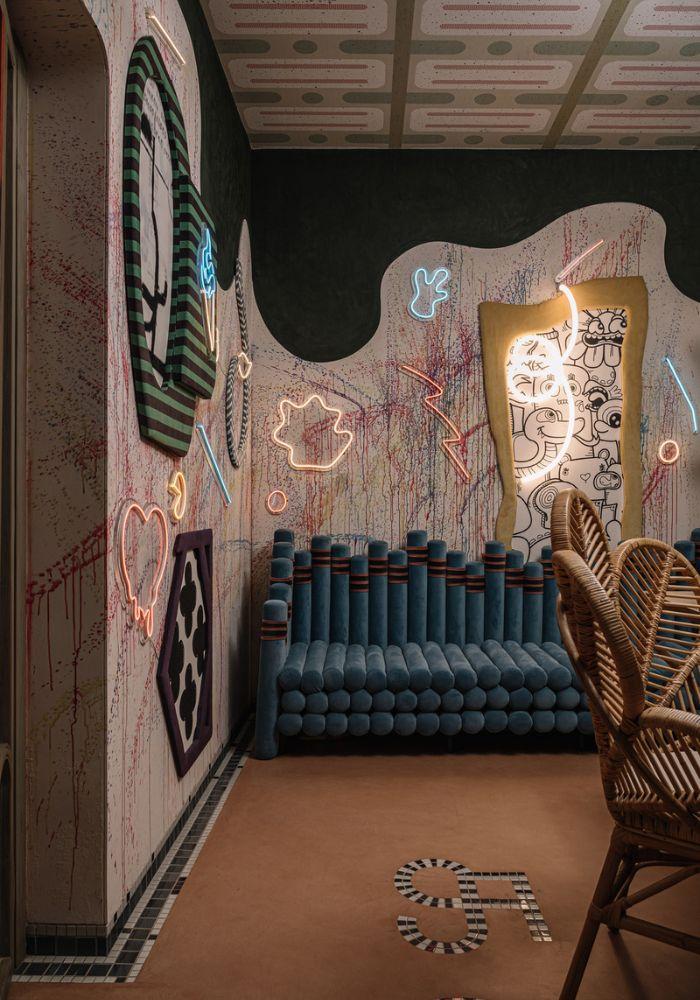
The foyer presents Indian craftsmanship in a playful, almost poetic way. One wall conceals a shoe cabinet designed to resemble intertwined shoelaces, while textured wallpaper frames the space. Here, MOS’s signature style already becomes apparent: everyday functions are given an artistic, often humorous twist, patiently waiting for the moment of discovery. Rooms that tell stories.


The living and dining area forms the heart of the house – and is equally filled with subtle surprises. Two tables designed by MOS define the atmosphere: one inspired by the phases of the moon and surrounded by armchairs crafted from aged wood. The other recalls abstract leaves through its organic form.
An L-shaped marble lounge with a canopy immediately draws attention. It is decorated with tiny birds made of glass, brass and steel, among which blossoms bloom like flowers in a garden sky. The dining area is dominated by a large table crafted from two-toned wood, whose trapezoidal legs create a sculptural presence.
Materiality as an Accent
“We wanted furniture that is not only functional but also meaningful,” explains Thomas. In fact, around 80 percent of all furnishings were custom-made in collaboration with artisans from across India.

The materials themselves provide remarkable highlights: glossy tiled surfaces on the upper floor, textured walls in the dining area, and mosaic floors that emphasise the transitions between rooms. Even secondary spaces surprise, such as the guest bathroom, where a vivid red tone disrupts the minimalist setting.
Even functional spaces like the kitchen remain meticulously designed. Divided into three zones – a dry kitchen, utility kitchen and pantry – it combines functionality with a clear spatial organisation.


The bedrooms, by contrast, unfold an atmosphere of tranquillity and modernity. The master bedroom is generously proportioned and intentionally understated. Its clean lines and combination of wood and textiles lend it an elegant restraint that contrasts with the richly detailed public areas of the house.
Architecture as Craftsmanship
As diverse as the rooms may appear, they all share one central principle: craftsmanship is not simply decoration but the very foundation of everything. MOS deliberately avoided standardised products and mass-produced goods. Instead, natural stone, solid wood and brass were sourced locally and crafted by hand. Surfaces are free from aggressive chemicals, benefiting not only the environment but also the indoor air quality.



“Every piece was created with intention,” says Thomas. “We rely on raw materials and innovative techniques to build a deeper connection with both the environment and the community.” This philosophy runs throughout the residence: from carved wooden panels to handcrafted brass bands, every detail tells a story of skill, patience and cultural rootedness.
Sustainability in More Than One Sense
Pennyroyal Tea understands sustainability not only in ecological terms but also as a social commitment. During construction, waste was minimised and recycled materials were used to reduce the building’s carbon footprint. Equally important was the involvement of artisans, supporting local craftspeople and small businesses. By bringing together stonemasons, carpenters, tilers and metalworkers from different regions, MOS created a network that now extends far beyond the completion of the house. The project strengthened local communities while helping preserve traditional skills both economically and culturally.

In doing so, Pennyroyal Tea challenges the prevailing logic of many construction projects. At a time when speed and efficiency often dominate, can architecture still be a slow, participatory process that preserves and passes on traditional craftsmanship?
A House as a Living Canvas
Although Pennyroyal Tea is technically a private residence, it reads like an open archive of Indian craftsmanship. Its rooms are more than mere settings; they are active storytellers – from the marble daybed in the living room to the floral engravings of the entrance door.
Pennyroyal Tea feels both contemporary and timeless. It draws on centuries-old techniques without becoming nostalgic. It celebrates diversity within a clear design language without slipping into arbitrariness. And it proves that contemporary residential architecture can achieve global relevance while remaining radically local.
Ultimately, Pennyroyal Tea is far more than an aesthetic product. It is a manifesto for conscious building that not only preserves craftsmanship but also carries it confidently into the present. It demonstrates how architecture can express cultural identity, embrace ecological responsibility and strengthen social structures – all without diminishing the magic of wonder.
Text: Linda Benkö
Fotos: Pennyroyal Tea/Ishita Sitwala