




We plan, organise and optimise – and then life intervenes. Uncertainty cannot be avoided. But perhaps it doesn’t need to be. The art lies less in having everything under control than in learning how to navigate the unpredictable.

“In this world, nothing can be said to be certain except death and taxes,” Benjamin Franklin famously observed. More than two centuries later, the words feel remarkably contemporary.
Rarely has our desire for certainty seemed quite so pronounced. We plan careers, relationships, journeys, finances and sometimes even our free time down to the smallest detail. Vision boards meet to-do lists; five-year plans accompany carefully curated ideas of what our lives are supposed to look like.
And then something happens that wasn’t part of the plan.
A flight is cancelled. A job disappears. A relationship ends. An opportunity we counted on vanishes. Or we simply wake up one morning with the feeling that the path we so carefully mapped out no longer seems to be the right one.
Uncertainty often begins precisely there: in the space between what we expected and what actually happens.
A World Without a Roadmap
Technological developments, social change and the constant flood of information can intensify the sense that the world is changing faster than we can understand it. What seemed certain yesterday may already be questioned tomorrow.
For younger generations in particular, finding direction within this environment can be difficult. Research published by the Harvard Graduate School of Education in 2023 showed that a significant proportion of young adults in the US struggle with a lack of purpose, direction and concerns about the future.
But perhaps part of the problem lies in the assumption that we should always know where our lives are heading.
School and university provide us with a relatively clear structure for many years: semesters follow semesters, exams follow courses, qualifications mark the next stage. Then suddenly, a vast space of possibilities opens up – and possibilities can be as intimidating as they are liberating.
So perhaps the essential question isn’t: How do I eliminate uncertainty? It is: How do I learn to move through it?
Control What Can Be Controlled
When something unexpected happens, our minds tend to respond with a curious reflex: precisely because we are losing control, we attempt to control even more.
A simple distinction can help. What can I influence – and what can’t I?
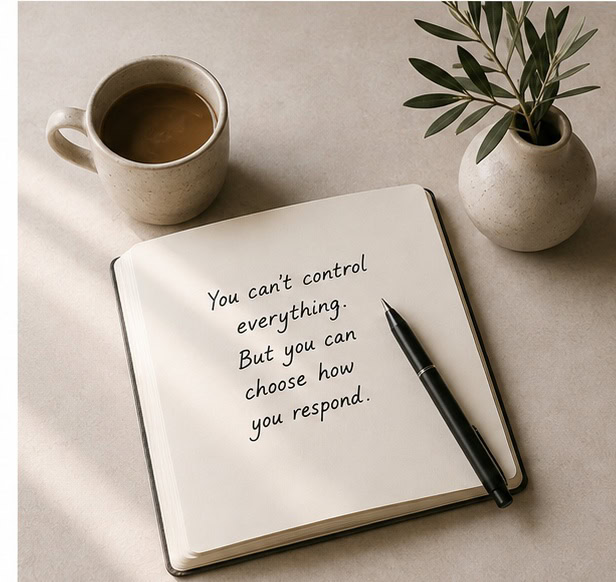
The weather, other people’s decisions, economic developments and much of what may happen tomorrow remain beyond our control. What we can influence is our response, our next step and the way we choose to engage with a situation.
It sounds simple, but it can fundamentally change our perspective.
If a flight is cancelled because of bad weather, frantically rushing between gates will not make the storm disappear. Gathering information, exploring alternatives and then making a decision is far more useful.
Calmness does not mean passivity. Quite the opposite: it creates the mental space in which meaningful action becomes possible.
Plans Are Good – As Long As They Can Move
Planning is not the enemy of uncertainty. It can provide direction, reduce complexity and transform an overwhelming problem into a series of smaller, manageable steps.
What matters is how tightly we hold onto the plan.
Perhaps a good plan should be less like a precisely drawn route and more like a compass. It provides direction while allowing us to change course along the way.

This applies to a stranded airline passenger just as much as it does to life’s bigger questions. We can gather information, make decisions and take action. What we cannot do is guarantee that our actions will produce exactly the outcome we imagined.
And this is where a quality that can feel almost radical in a world built around optimisation and control becomes important: letting go.
The Freedom of Not Knowing
Letting go does not mean becoming indifferent. Nor does it require believing that everything will somehow magically work out for the best.
It simply means recognising the limits of our influence.
Perhaps we don’t need an immediate answer to every question. Perhaps a chapter of life is allowed to remain open. A decision can be provisional. And a detour does not necessarily mean we have taken a wrong turn.
Looking back, many of life’s defining changes emerge from circumstances we would never have chosen ourselves. That does not automatically make loss, disappointment or fear positive experiences. But it reminds us that, in the middle of upheaval, we cannot yet know what significance it may eventually have.
Uncertainty, then, is not the opposite of a good life. It is part of it.
Perhaps real security lies somewhere else entirely: not in knowing what is going to happen, but in trusting that we will be able to deal with whatever does.