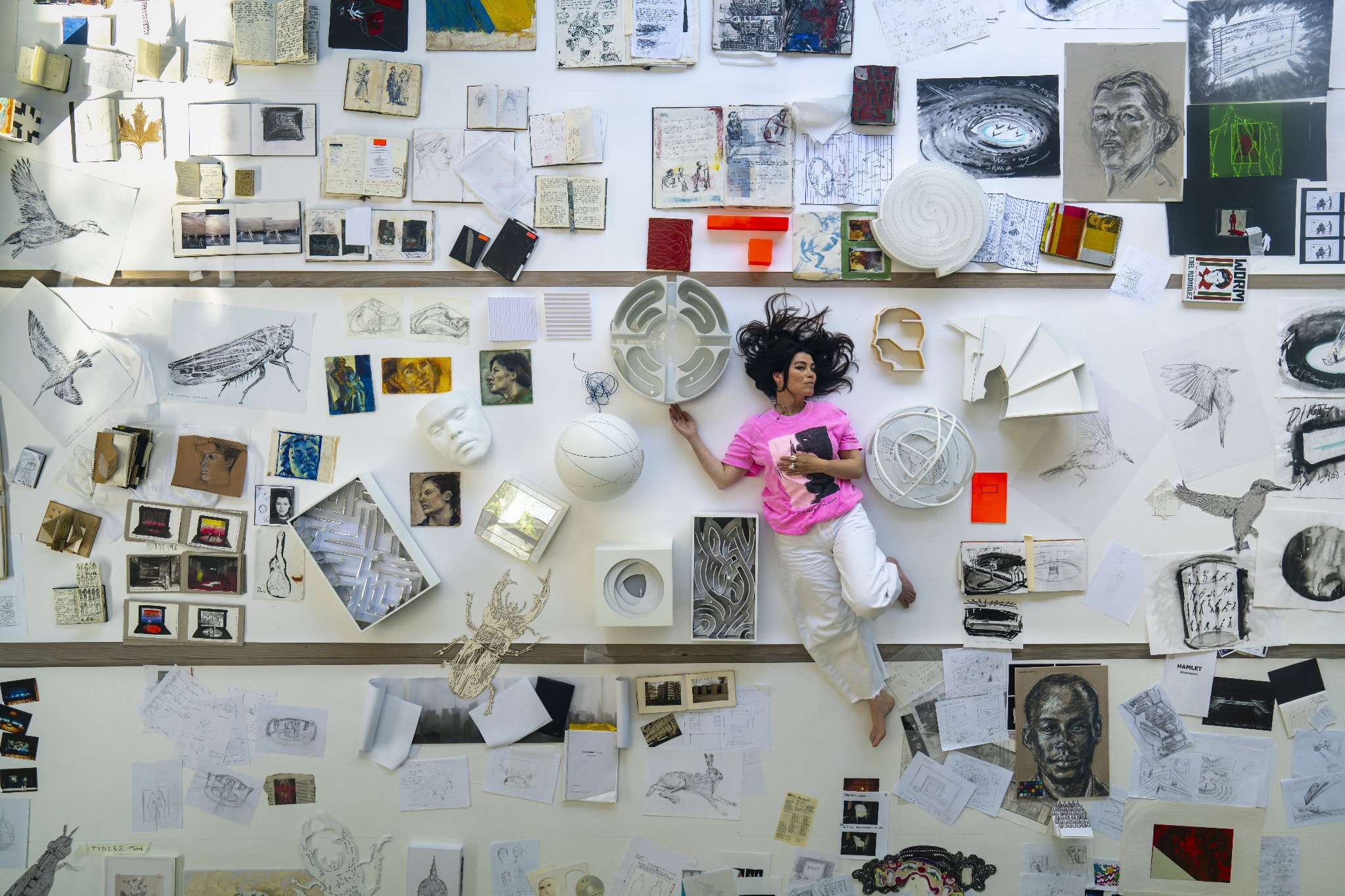
Es Devlin is among those artists who have long since moved beyond the boundaries of scenography. Her spaces are stages, sculptures, landscapes and social experiments at once. At London’s Design Museum, “Es Devlin: Other Worlds” traces a 30-year practice in Europe for the first time, spanning Shakespeare and Beyoncé, opera and artificial intelligence, vast stadium choreographies and endangered biodiversity.
A stage is never merely a backdrop for Es Devlin. It can rotate, glow, disappear, turn into a mirror or become a surface for projected words. Above all, it changes the audience’s position. This shift from looking to experiencing is at the heart of “Other Worlds”, the first European retrospective of the British artist and designer at London’s Design Museum. Running from 2 October 2026 to 4 April 2027, the exhibition brings together three decades of work, revealing something easily overlooked in the spectacular finished productions: how much thinking, drawing, discarding and model-making lies behind the grand performance.
Born in London in 1971, Devlin first studied English literature at the University of Bristol before taking a foundation course in fine art at Central Saint Martins. The Motley Theatre Design Course eventually led her to stage design. She began her professional career working for smaller London theatres in 1995 and received the Linbury Prize for Stage Design the following year. From theatre, her path took her through opera and dance towards the scale at which stage sets become temporary architecture.
The decisive leap came in the mid-2000s. In 2005, Kanye West commissioned Devlin for his “Touch the Sky” tour. Projects including “Glow in the Dark” and “Watch the Throne” with Jay-Z followed. Beyoncé, Adele, U2, The Weeknd and other musicians joined the list. For these productions, Devlin devised spatial systems bringing music, bodies, movement, film and light into a shared event. A giant LED cube became a moving stage for U2; for Beyoncé, she created the rotating monolith of the “Formation” tour. Her stadium concert work reached audiences on a scale no theatre could match.
Space Is Narrative
That Devlin never simply became a specialist in spectacular pop shows has much to do with her roots in theatre. There, space is always also narrative. A set determines what is seen, from which perspective and how performers and spectators relate to one another. This experience runs through all her work. Cooper Hewitt, which presented the first monographic museum exhibition devoted to Devlin in 2023–24, describes her process as a progression from a first line on paper through drawings and studies to a model and, ultimately, a built work.
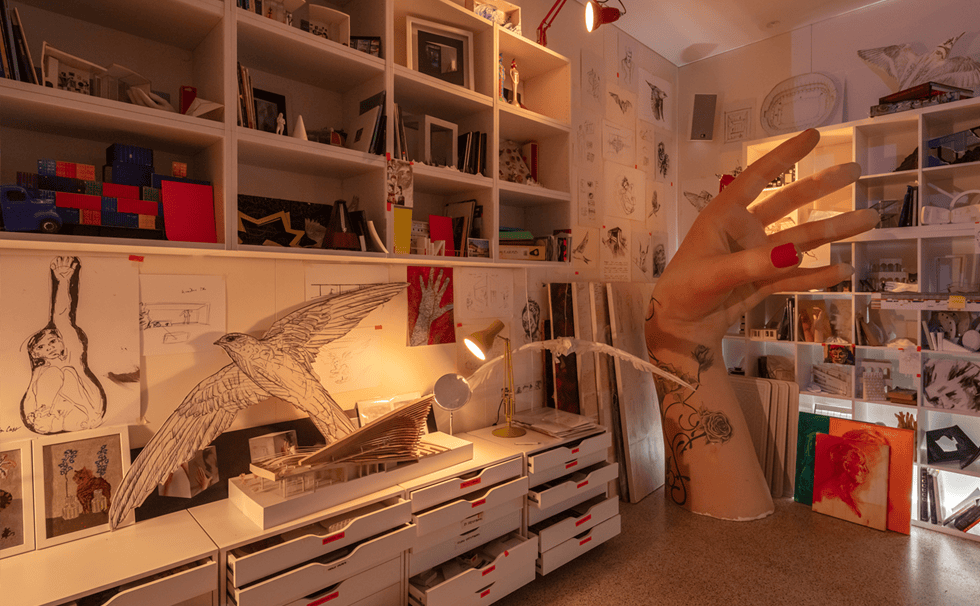
In London, that process becomes an exhibition subject in its own right. Visitors first enter a reconstruction of Devlin’s studio in south London: books, paints, tools, models and drawings appear as the materials of an ongoing thought process, rather than relics of a completed career. The “30-Year Desk” brings together designs, photographs, personal objects and ephemera. “Archive Unboxed” reaches further back to early drawings, paintings, collages, diaries and prints from her school, university and art college years.
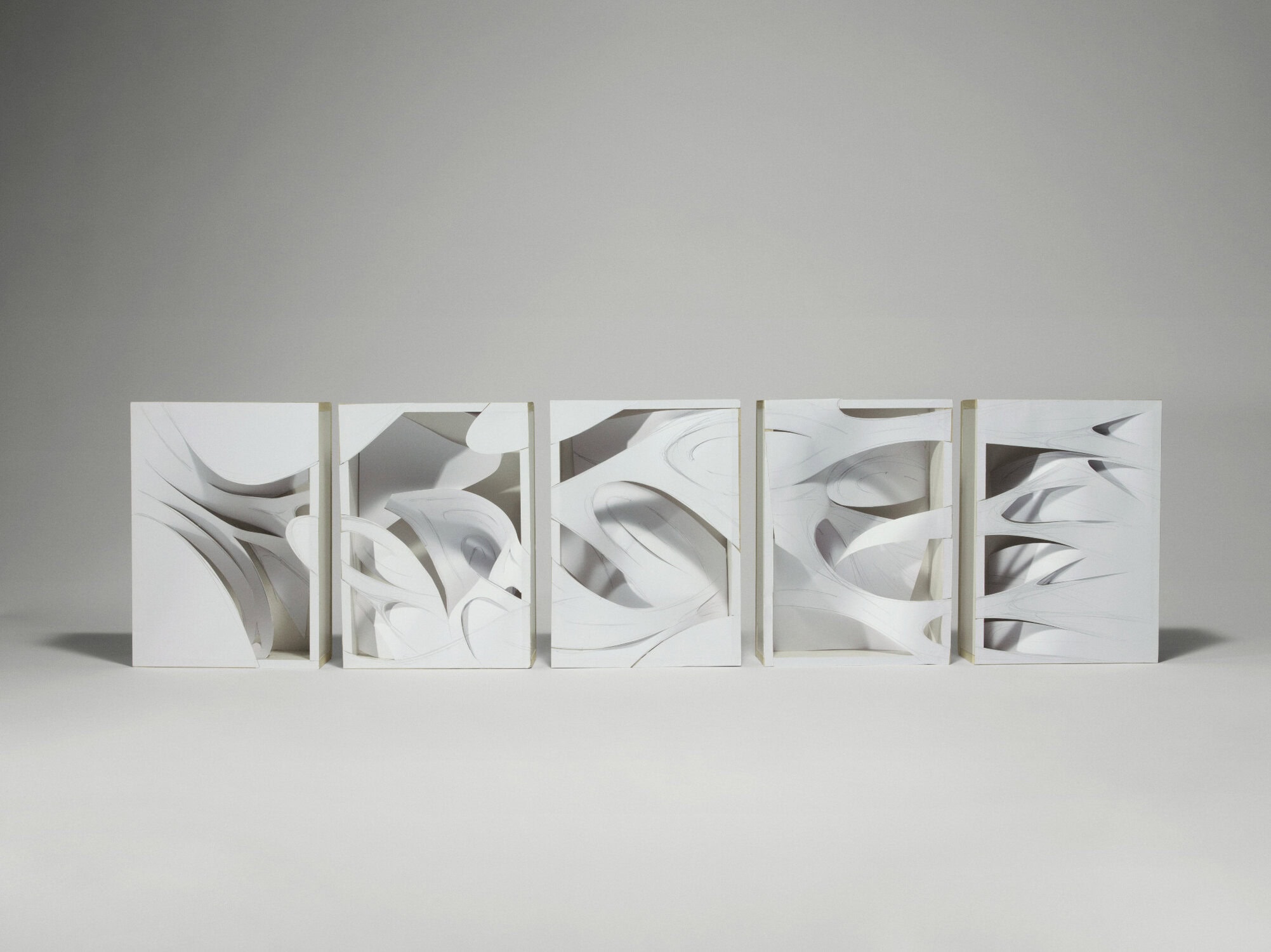
This goes beyond maintaining an archive. For Devlin, drawing is not a preparatory medium that disappears once a project is built. It is how she thinks. This also explains the curious kinship between works that seem far apart: a motif, a geometric form or a spatial idea can reappear on a theatre stage, in an installation or at a concert, changing its meaning along the way. Cooper Hewitt aptly describes these works as “ephemeral architectures”: architectures created for a particular moment, a particular community and a particular way of seeing.
From Biodiversity to the Crises of the Present
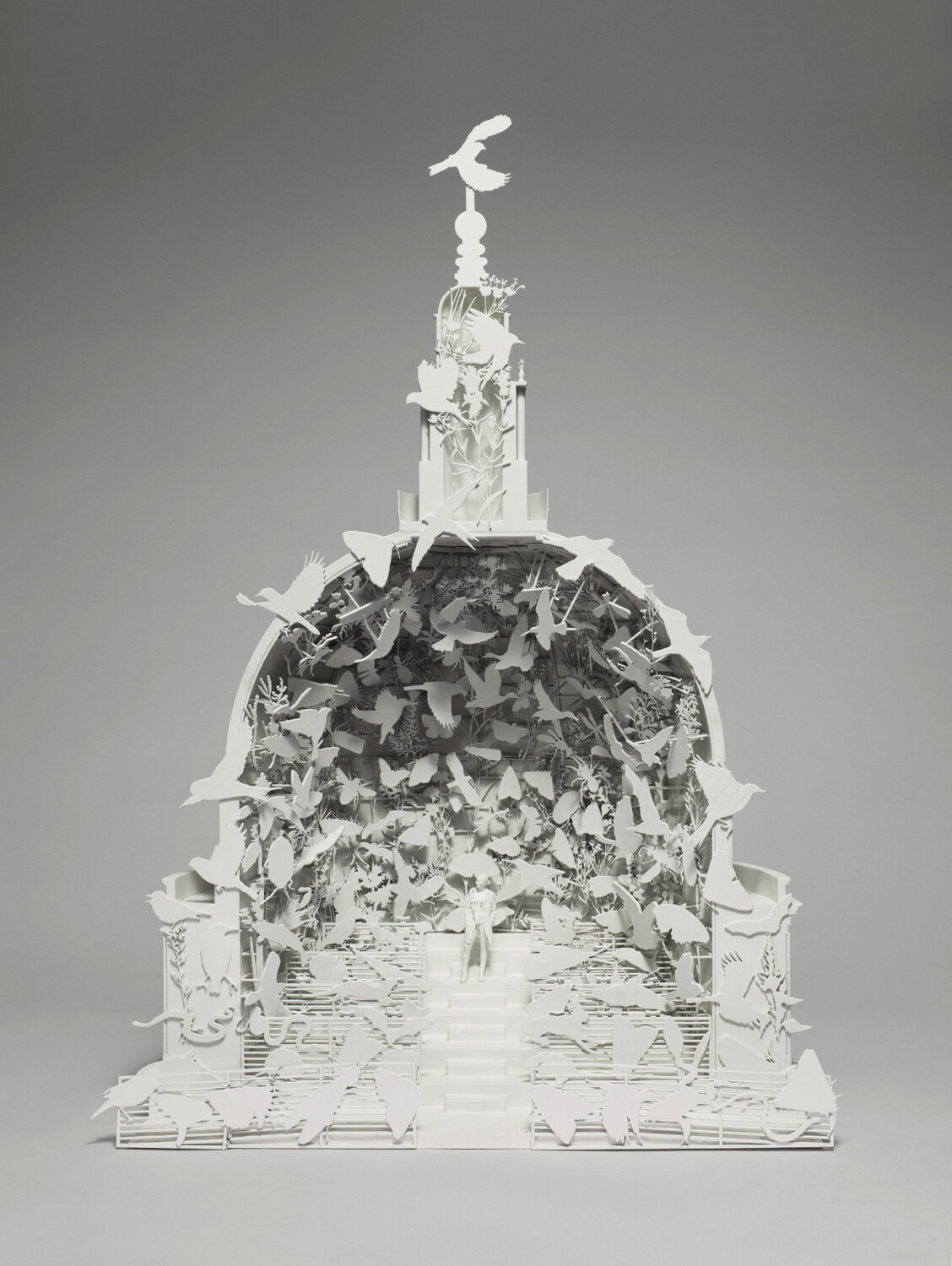
Among the works reconfigured for London is “Come Home Again”. For the installation outside Tate Modern in 2022, Devlin designed a cross-section through the dome of St Paul’s Cathedral. Outlines of endangered moths, birds, beetles, wildflowers, fish and fungi were cut into the monumental form and illuminated. Created with support from the London Wildlife Trust, the work turns an architectural landmark into a kind of oversized archive of life.
It reveals a development that has increasingly shaped Devlin’s practice in recent years. Her early stage designs revolved around characters, stories and music; later installations focus more closely on the audience itself and on questions of shared perception. Biodiversity, linguistic diversity, artificial intelligence and the major crises of the present are not subjects applied to a form after the event. They change the form itself.
A particularly vivid example is the British Pavilion for Expo 2020 in Dubai. Devlin designed a 21-metre-high conical structure whose illuminated façade displayed poems fed by visitors’ words. An algorithm continuously generated new poetic texts from the submitted terms. Technology was intended to enable a form of collective authorship: visitors supplied the material, and the machine rearranged it.
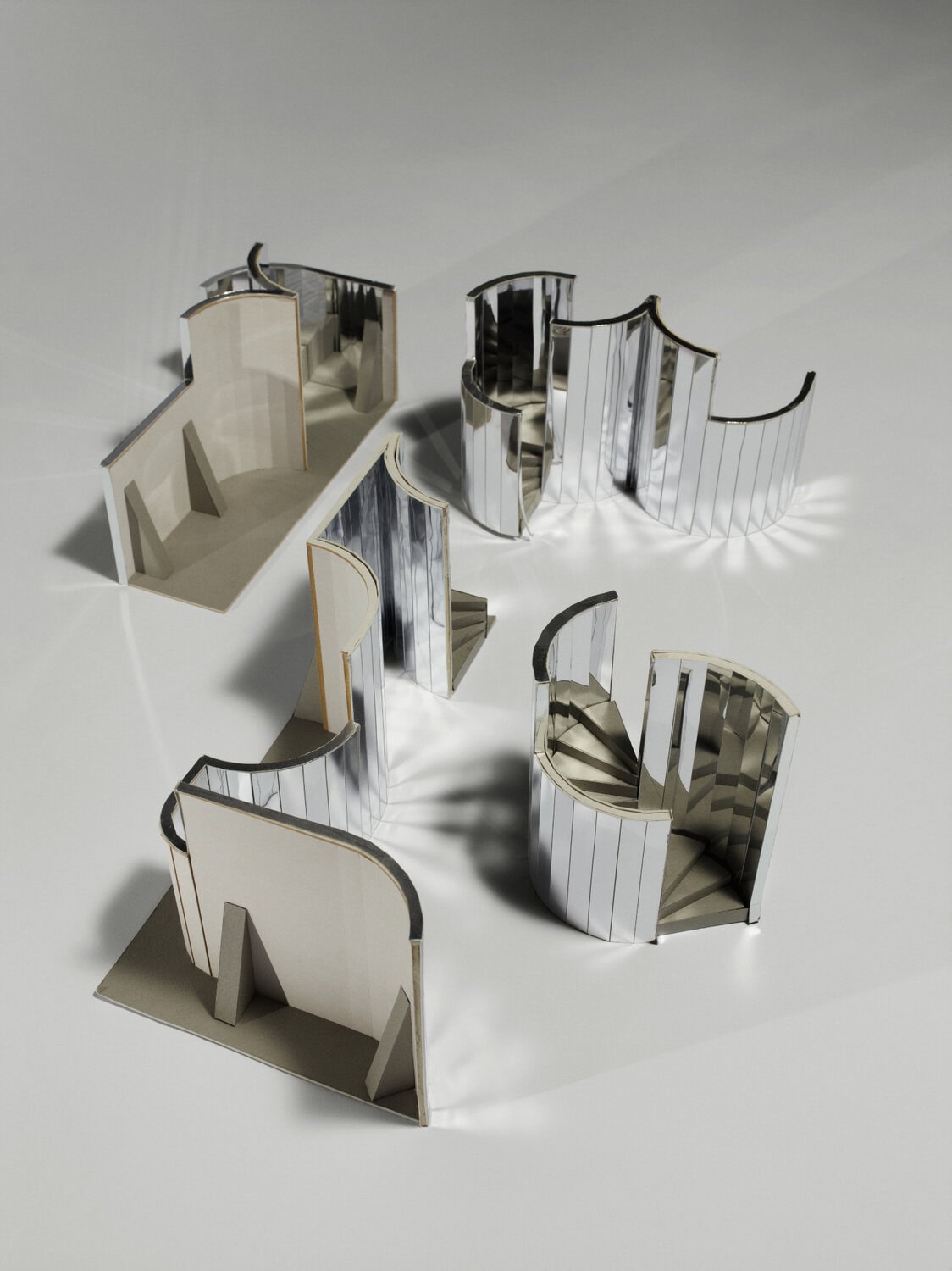
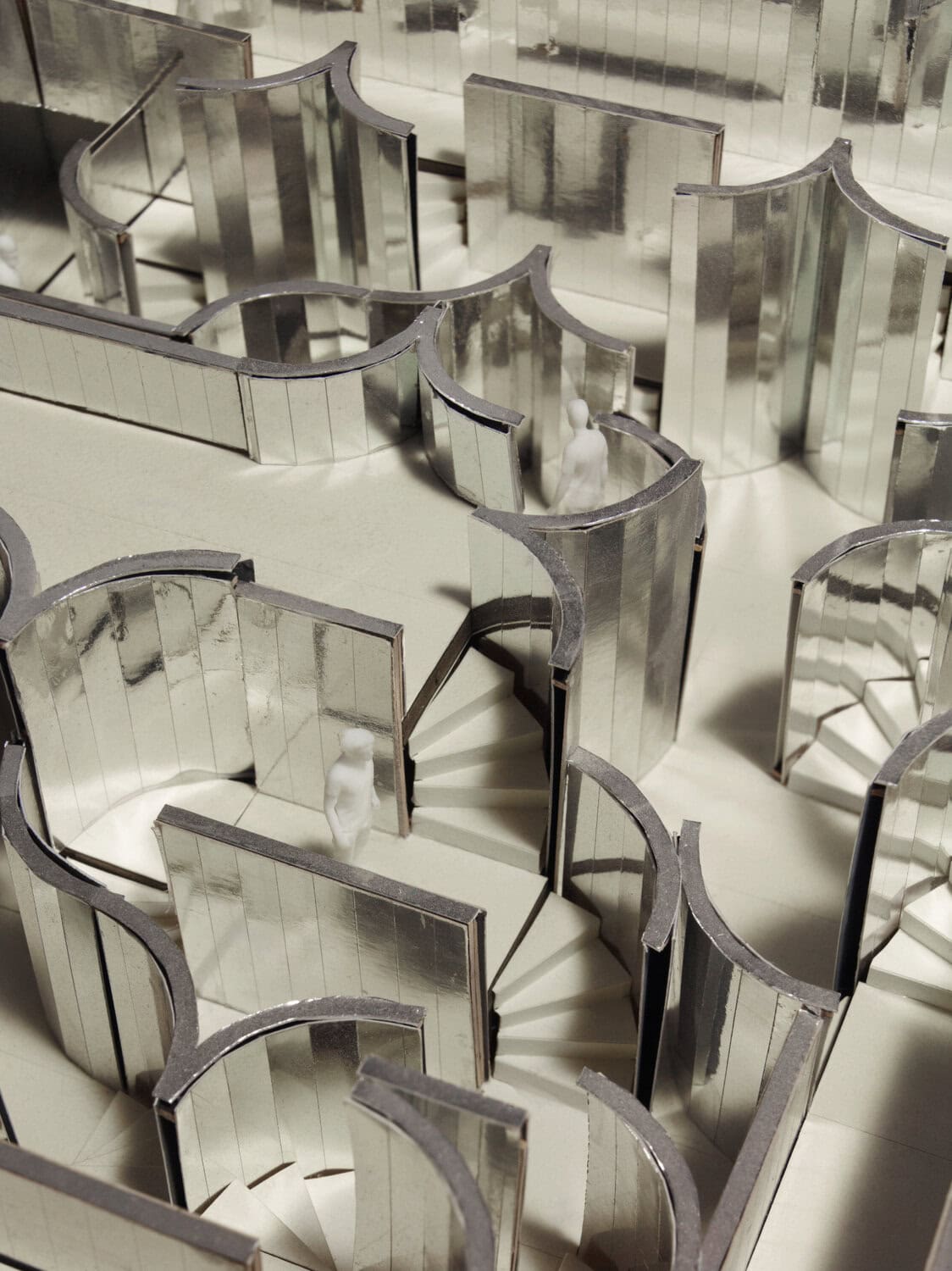
“Forest of Us”, shown in Miami in 2021, follows a similar line of thought. The walk-through installation translates a forest’s branches and structures into a spatial, mirrored geometry. Visitors move through a landscape that reflects their own physical and social existence back at them. It is characteristic of Devlin that such works resist choosing between sculpture, architecture and stage design. Their interest lies in what emerges between these disciplines.
An Audience Becomes a Temporary Society
Devlin calls the audience a “temporary society”. The phrase explains an essential aspect of her work: she is interested not only in what a work depicts, but in what people do together within it. In a theatre, this is familiar. Hundreds of people sit in the dark, focusing their attention on the same point. Devlin transfers this social choreography to museums, squares, concert halls and public spaces. An audience becomes a community for a while.

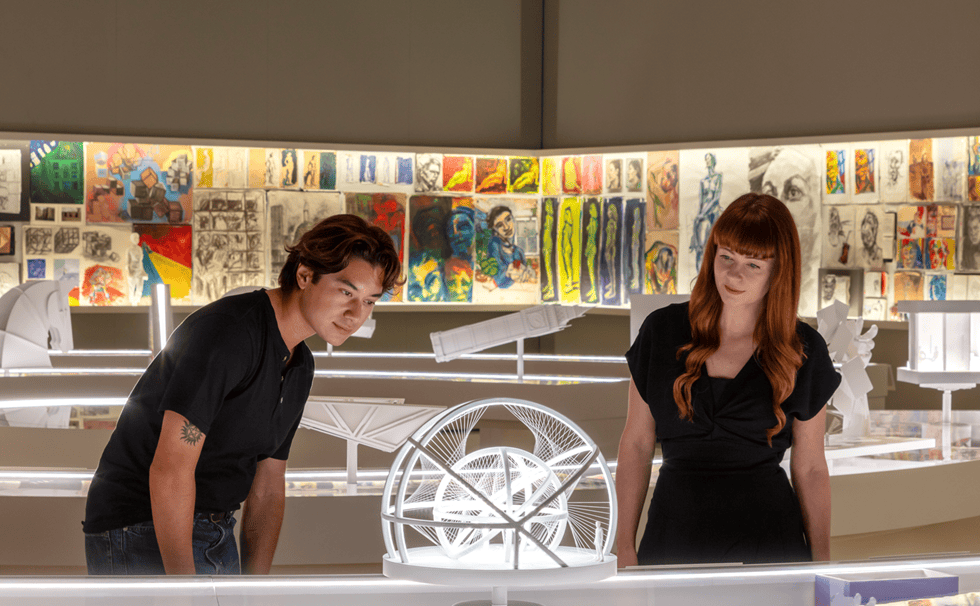
That her work often looks spectacular is almost a side effect. Devlin commands the grand gesture, yet begins on a small scale, with pencil and paper. Her career can be read as the continuous enlargement of a drawing. A sheet becomes a model, a model becomes a stage, a stage becomes an installation, and an installation finally becomes a space through which other people move. In this sense, Devlin is less a stage designer who makes art than an artist who uses the means of theatre to think about space, time and community.
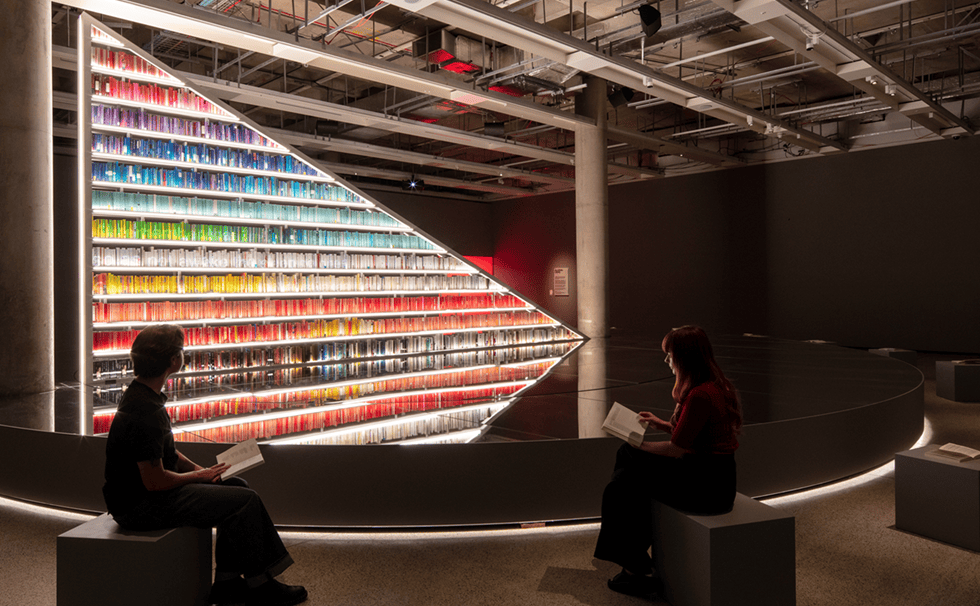
“Other Worlds” brings this development back to its starting point. The archive sits at the heart of the exhibition, alongside the finished works. Designs, models and notes become a landscape of their own. Joining them is “Infinite Library”, an installation of books that will be donated to local charities after the exhibition closes. Here, too, the book is part of an idea of knowledge as something that circulates and is passed on.
Seen this way, the exhibition’s title is well chosen. “Other Worlds” is not about escaping into fantastic parallel universes. It concerns the ability to design spaces that make another perception of the world possible. Devlin builds situations in which we suddenly see ourselves, other people and the space between us differently. That such a practice is now being presented at the Design Museum makes sense. Devlin has long worked in an expanded field in which design is no longer confined to objects. Her materials are light and language, movement and scale, technology and memory, audiences and time. And her particular speciality may be precisely that fleeting form so difficult to collect: the shared moment in which many individuals briefly become an audience.
Es Devlin: Other Worlds
2 October 2026 – 4 April 2027 · Design Museum, London
Exhibition information
Read also: Es Devlin and the Art of Connection
Featured image: Es Devlin amongst her archive. Photo: Daniel Devlin / @susakpress.