
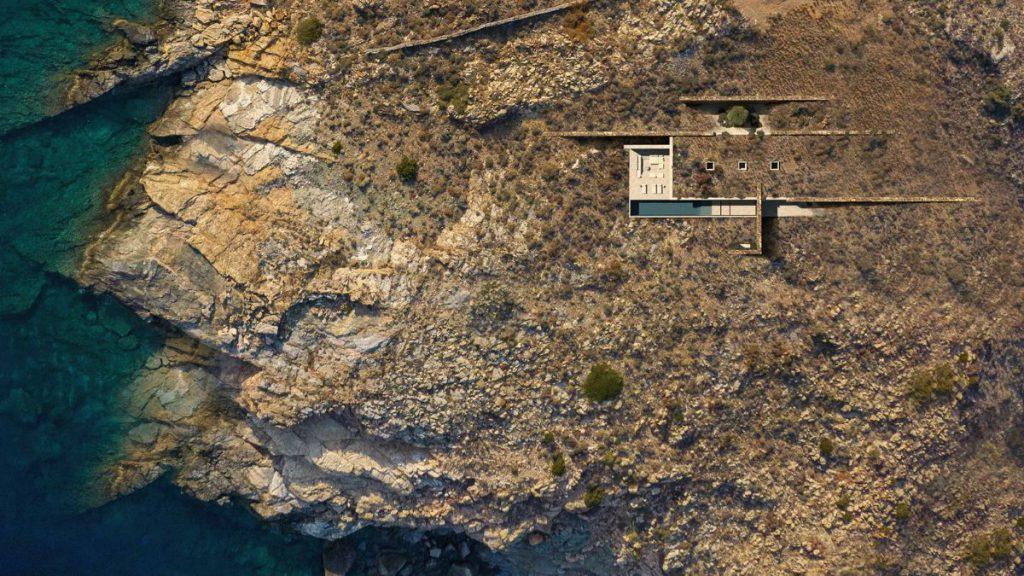
Is regenerative architecture the logical continuation of sustainable architecture? With the Horizon House on the Cycladic island of Syros, ONUS Architecture Studio has achieved precisely that.
The Cyclades, an archipelago in the Aegean Sea that includes the island beauty of Santorini, are known for two things: their contrasting landscapes of rocky mountains, fertile valleys and rugged coastlines. And secondly, for the idyllic architectural imagery they offer. Cubic whitewashed houses with blue shutters and rounded domes, artfully arranged along steep hillsides, create a striking contrast to the deep blue sea. Their charm captivates virtually everyone.
In complete contrast to these traditional building typologies stands Horizon House. Designed by ONUS Architecture Studio, the house represents a new form of sustainability that extends beyond resource efficiency. Yet it settles into the rugged terrain so naturally that it appears as though it has always belonged there.
Part of a Living Ecosystem
The design philosophy led by Athens-based architect Margarita Kyanidou is rooted in the belief that architecture should not merely do less harm, but actively heal. Horizon House on Syros embodies this ambition in every detail. It is not only energy self-sufficient but also ecologically restorative.


The stones extracted during excavation form the house’s massive walls, allowing Horizon House to follow the natural contours of the landscape. Recycled wood and raw textures integrate the building into the local material cycle. This deliberate reliance on local resources becomes not only an ecological choice but also an aesthetic one: the house feels like a continuation of the landscape itself, a geological formation framing the horizon rather than interrupting it.
Between Shelter and Openness
The architectural concept plays with two polarities: rootedness and openness, retreat and outlook. The northern façade nestles protectively into the ground, while the southern side opens generously toward the Aegean Sea. The overall form of the house stretches parallel to the coastline.

An L-shaped pool marks the threshold between architecture and landscape. It acts as both a thermal and visual connector, carrying the reflected light of the sky into the architecture. Inside, the language of simplicity continues. Reduced geometries and natural materials create spaces of almost monastic calm. The interiors are organized around cross-ventilation, daylight and views. Three square skylights, for example, draw the sky directly into the house.
A Habitat for Nature Itself
ONUS Architecture Studio deliberately speaks of regeneration rather than sustainability when describing Horizon House. The objective is not merely to destroy less, but to give more back. Vegetation plays a central role in this vision. The landscape design follows an ecological restoration strategy developed in collaboration with ecosystem researchers.


Almost exclusively native species of Cycladic flora were used, selected for their resilience to drought and salty winds. This planting strategy stabilizes the soil, prevents erosion and encourages the return of pollinators, insects and birds. The house thus becomes a habitat not only for people, but for nature itself.
“Blue Roof” System and Micro Wind Turbines
The green roofs function as living systems: they retain rainwater, reduce ambient temperatures and create microhabitats for flora and fauna. Up to 200 cubic meters of rainwater can be collected annually and processed through an integrated filtration system known as the Blue Roof. The treated water irrigates the vegetation, while recycled greywater closes the loop. This rigorously circular use of resources—water, energy and materials—transforms Horizon House into a closed ecological system.

The five micro wind turbines make practical sense, as the winds of the Aegean blow with remarkable consistency along the cliff tops. As a result, the building can be powered entirely by renewable energy. The system is complemented by geothermal piping that utilizes the thermal inertia of the earth to regulate indoor temperatures. Mechanical heating and cooling systems are therefore unnecessary.

This strategy is informed by the scarcity of resources on the island, which serves as a powerful driver of efficiency and innovation. The house stands autonomously, independent of external infrastructure. Yet for ONUS, the goal has never been technological feasibility alone. Architecture, they believe, must also take responsibility.
The Poetry of Resonance
Despite its technical sophistication and linear exterior forms, Horizon House remains deeply poetic inside. Across a gross floor area of 230 square meters, an architecture of light and silence allows air, shadow, stone and wood to merge into an atmospheric continuum.


The living area opens toward expansive sea views and seems suspended between earth and sky. Natural cross-ventilation creates cooling that feels as though the house itself is breathing. The wind sweeping across the hillside is not resisted but guided—as part of a living system where resonance and harmony replace control.
The ONUS Ethics of Building
While sustainability is often considered a meaningful addition in many residential projects, it frequently remains an accessory or technical label. At ONUS, by contrast, every material, every line and every intervention is measured against its relationship to place—particularly at a time when the construction industry remains one of the largest contributors to global CO₂ emissions.
What emerges here is a model for regenerative island architecture that respects the cultural identity of the Cyclades while responding to the ecological challenges of the future. For a project that has not yet been built, Horizon House already feels remarkably real: not as a vision of tomorrow, but as a proposal for how architecture could once again become part of the living world.
Text: Linda Benkö
Renderings/Fotos: ONUS Architecture Studio