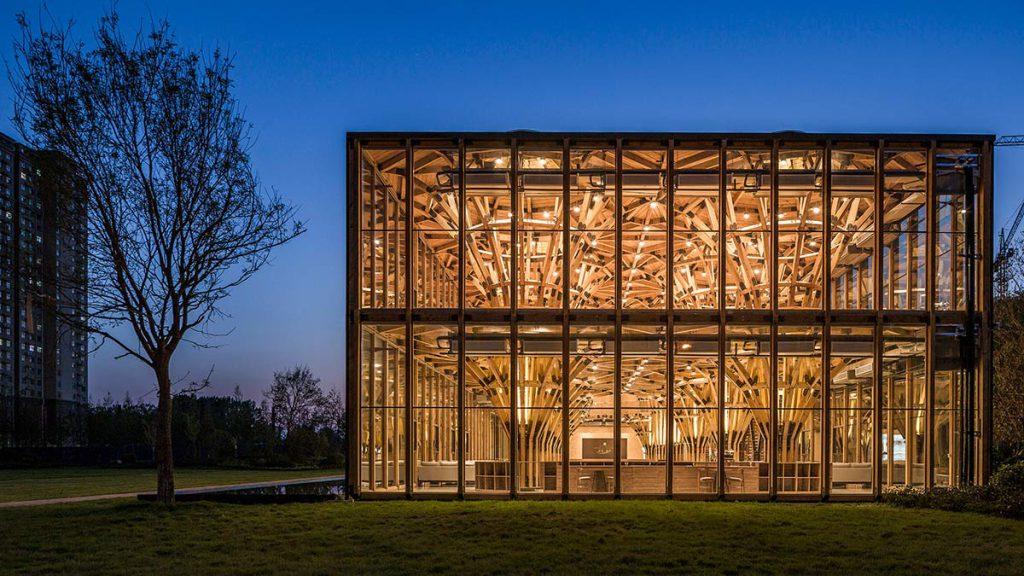
The architects at LUO Studio have designed a low-cost, modular timber construction system. As a prototype that adapts to suit requirements, Longfu Life Experience Center can be enlarged, downsized, or dismantled and relocated.
When Mies van der Rohe designed Chicago’s Crown Hall in 1956, he called it a universal space. Crown Hall is the main building of the College of Architecture, Planning and Design at the Illinois Institute of Technology, and even today – almost 70 years after its construction – it is regarded as one of the most significant buildings of the Modernist movement. At the time, van der Rohe described it as “the clearest structure we have done, the best to express our philosophy”.
The contemporary elements of Crown Hall’s design are its space that spans a surface area of 36 x 67 metres entirely without supports, and the resulting flexibility. This is precisely what is required of architecture today, and it has become a familiar mantra. After all, the lifetime of a building is longer if it is able to adapt. In addition, this enables more efficient use of resources and primary energy, which in turn helps to fulfil climate goals and – ideally – maintains the material cycle.
A clear signal in favour of timber construction
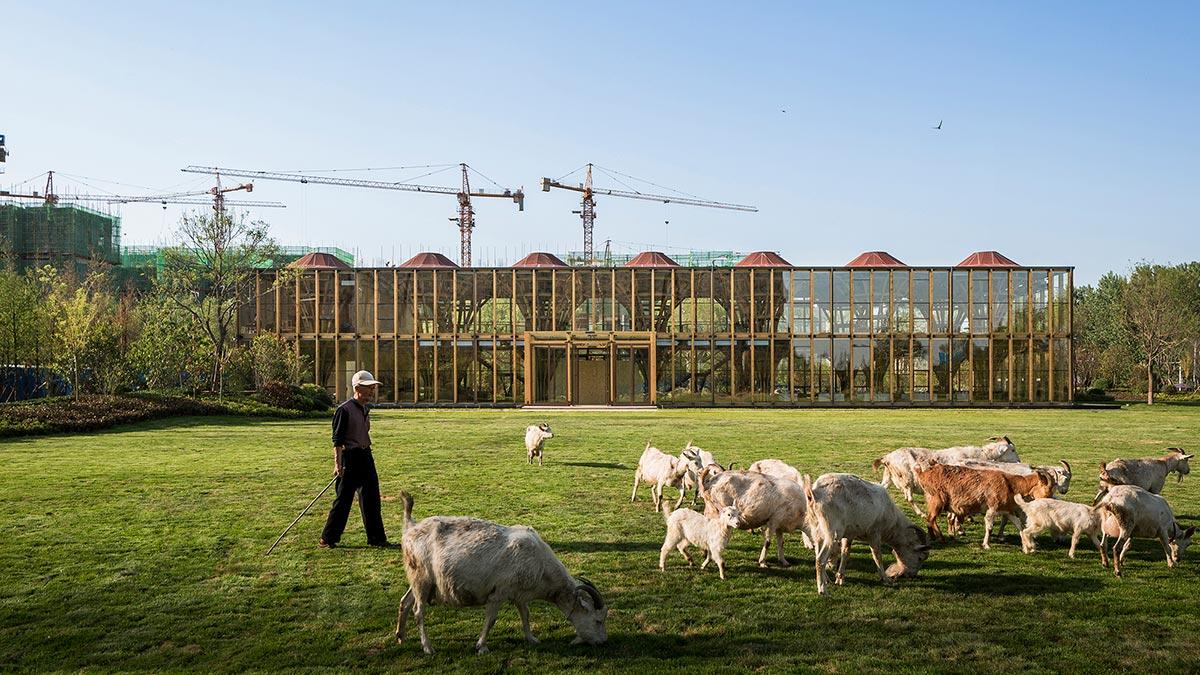
Creating a space that can change its function as required was also the aim of the architects at LUO Studio. Although Longfu Life Experience Center in the city of Puyang, China, was initially only conceived as a temporary sales office for real estate, they wanted to design more than just a cabin. The result is a building that offers an immersive experience, increases the value of its surroundings and can also be entirely dismantled.
Beijing-based architectural firm LUO Studio has already designed a number of timber construction projects, including a spectacular timber dome in Xiuwu County. In the case of this new project, timber was chosen as the material as it matched the client’s commitment to ecological living.
Timber is a natural material that suits the client’s corporate identity and is undoubtedly the ideal material for constructing the building.
LUO Studio, architects
“A green lifestyle is exactly what the client wanted to convey through the sales office,” remarks LUO Studio. “Timber is a natural material that suits the client’s corporate identity and is undoubtedly the ideal material for constructing the building.”
A multifunctional support structure
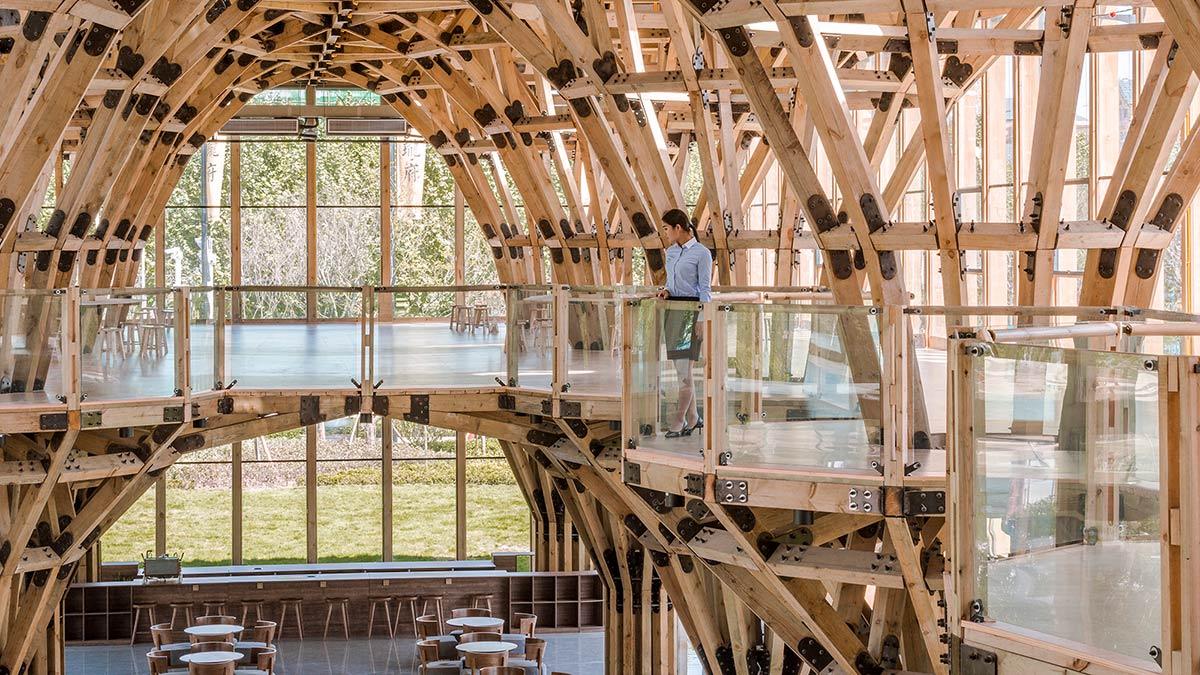
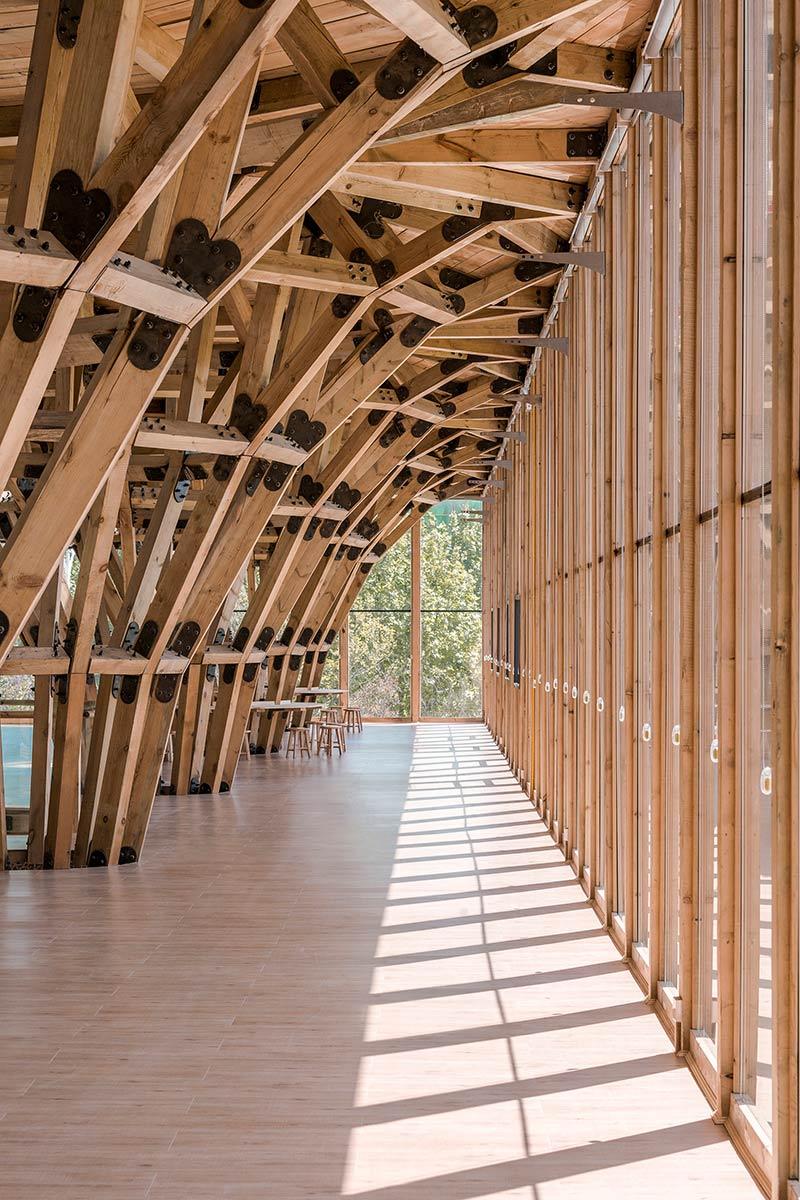
Even though Mies van der Rohe’s Crown Hall served as inspiration, for this project the architects approached the concept of universal space differently to the avant-garde Modernist architect. Instead of aspiring to create a large-span, support-free space, they designed a multifunctional support structure and a space that is virtually devoid of definite function.
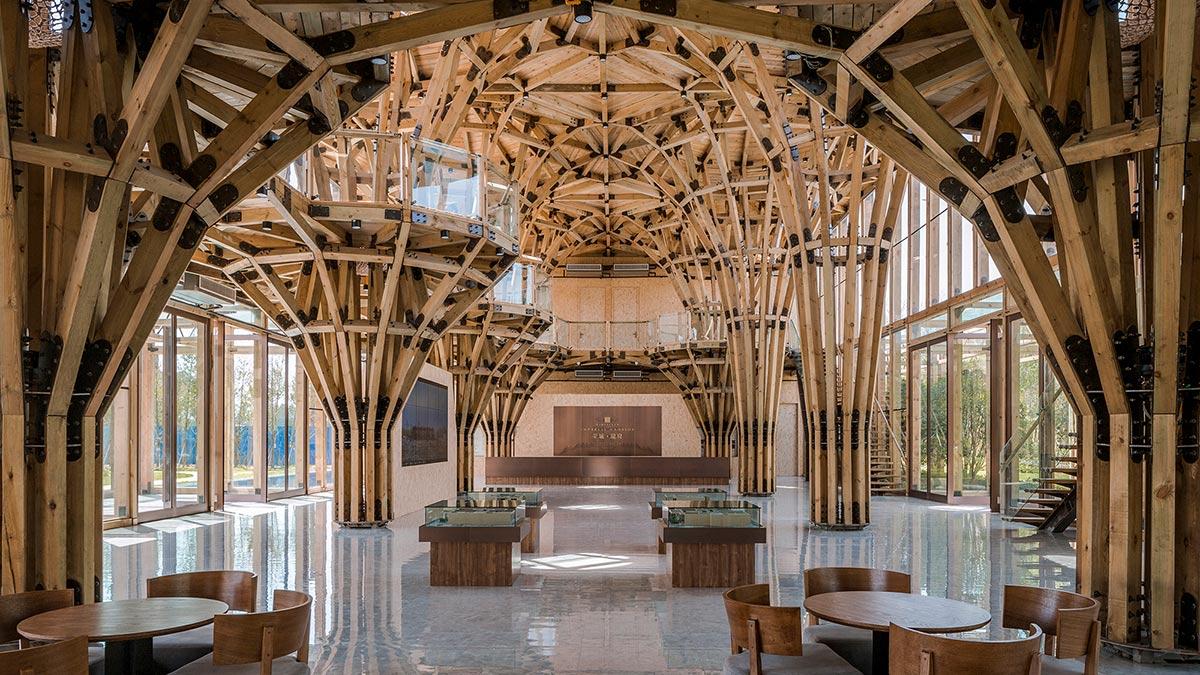
To achieve this, they chose a timber design with modules made of standardized constructional timber that are simple to reproduce. As a welcome side effect, this also helped keep building costs at a reasonable level. On the other hand, the architects limited functional areas such as staircases, washrooms and offices to the smallest possible spatial units.
We separated function and space, so as to eliminate functional constraints on the spaces.
LUO Studio, architects
Building technology and cables are integrated into the modular support structure, as are tables and seating. “In this way, we separated function and space, so as to eliminate functional constraints on the spaces.”
Modular clustered columns
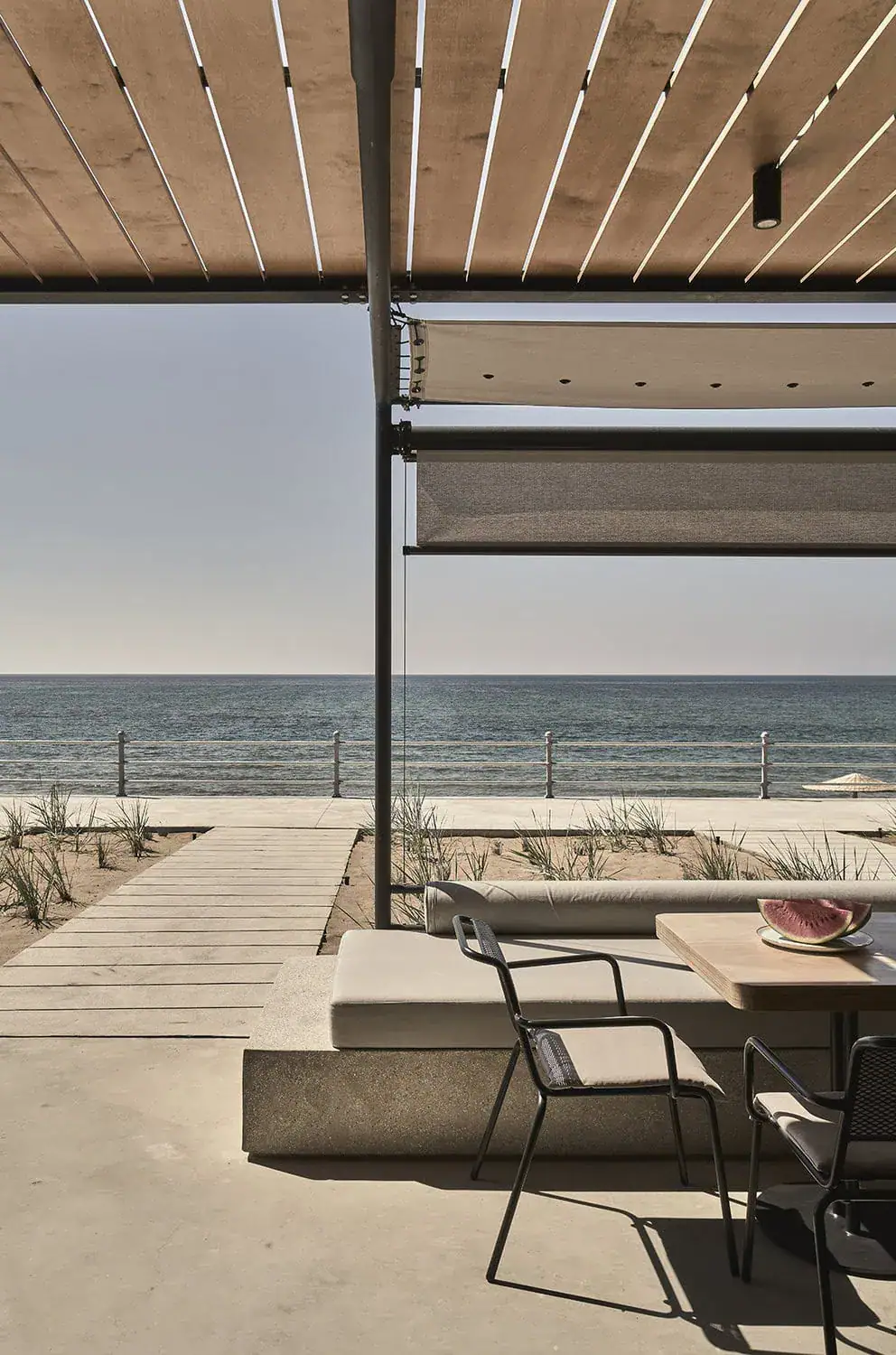
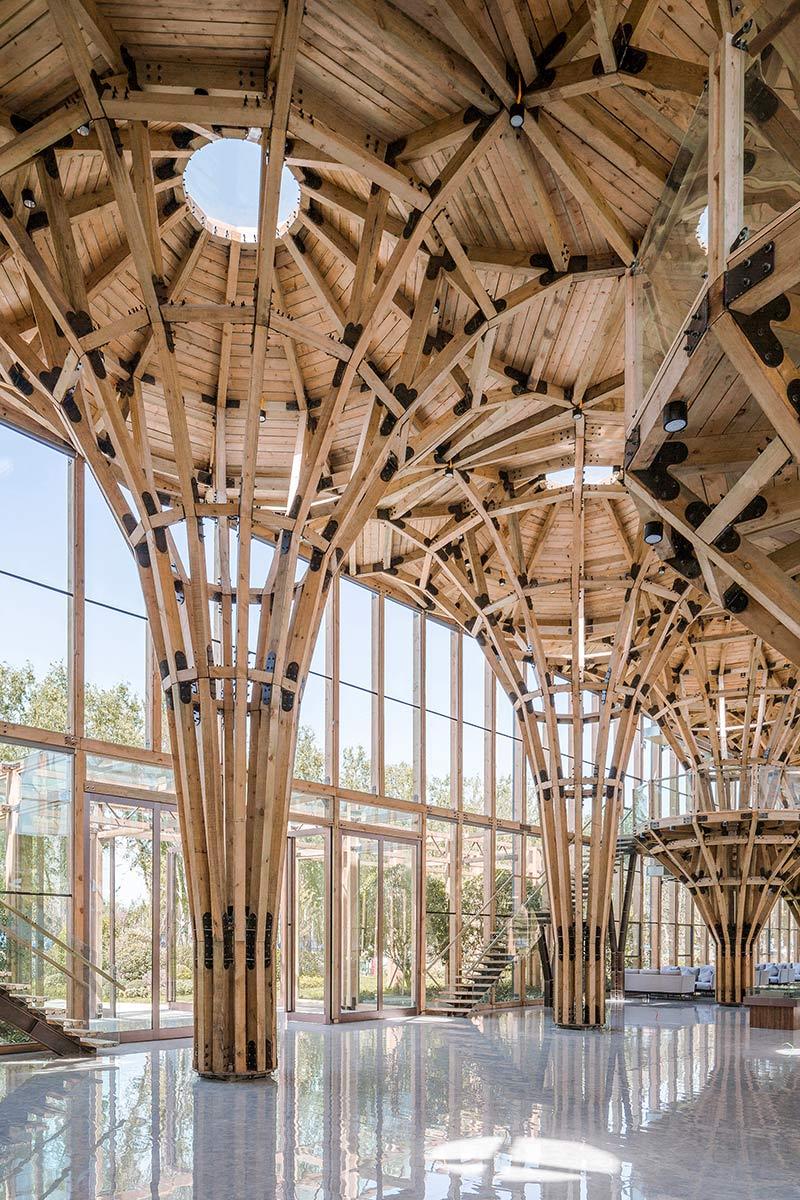
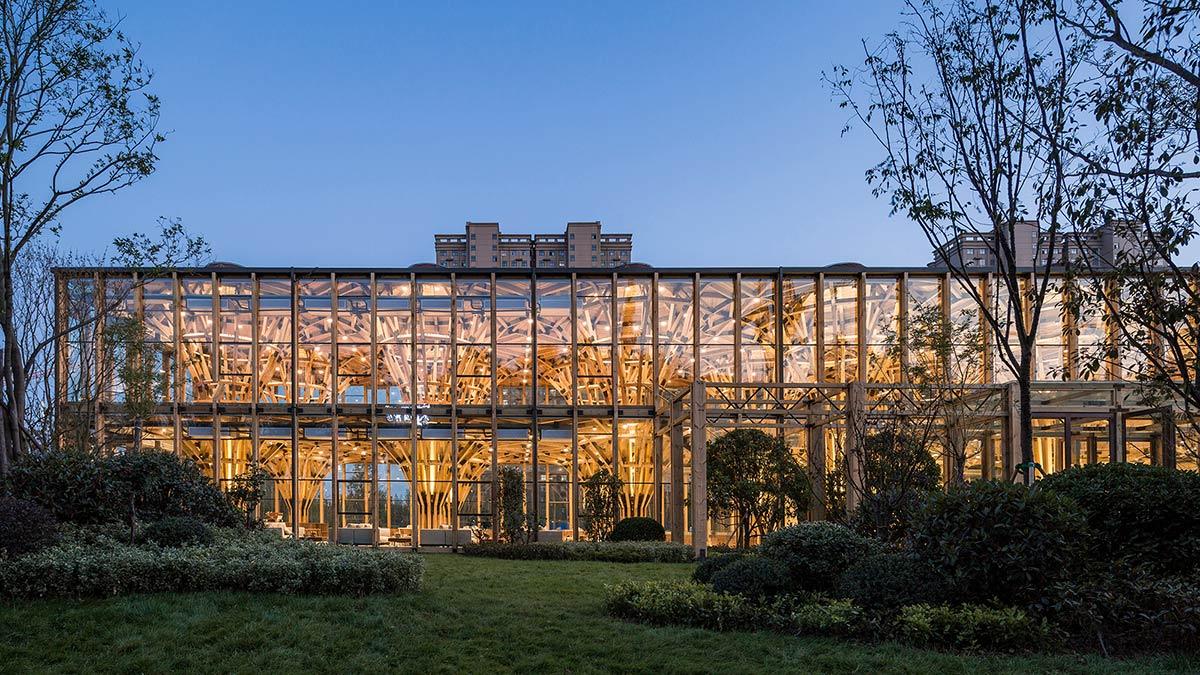
Longfu Life Experience Center is a prime example of biophilic design, with any boundary between interior and exterior being eliminated by the entirely floor-to-ceiling façade. Consequently, the greenery outside the building seems to be part of the wall-free space, aside from a few exceptions.
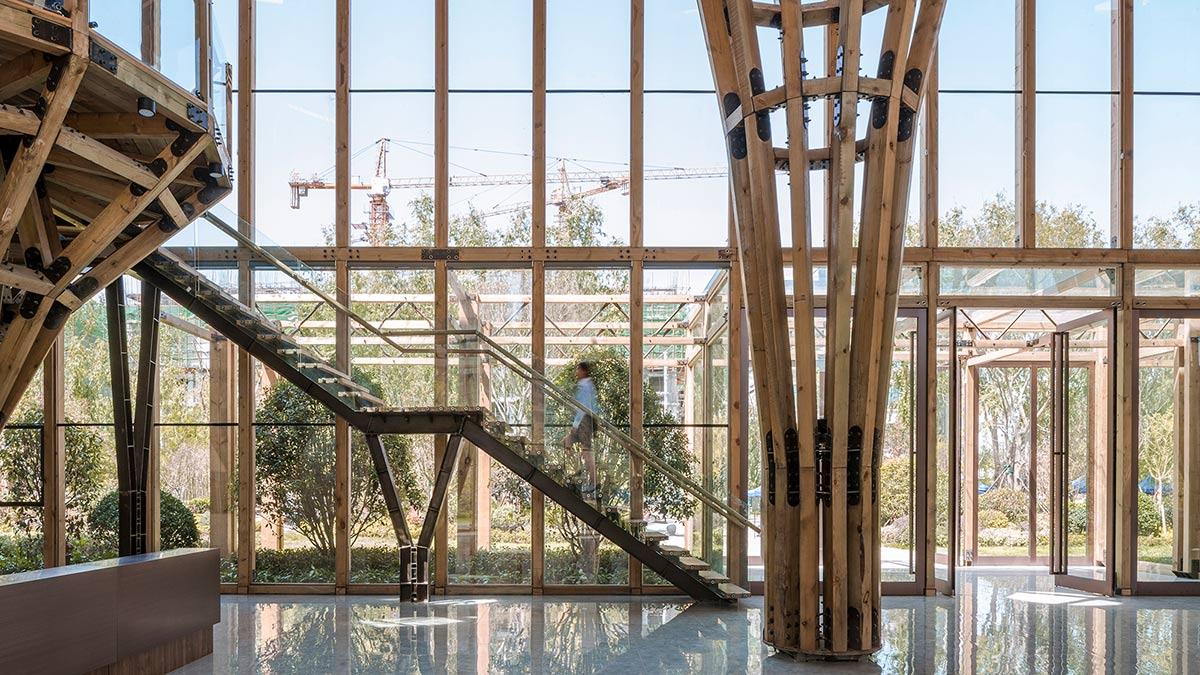
Modular “clustered columns”, as the architects call them, can be assembled using commercially available timber and conventional methods.
They branch out towards the top and merge to form a closed construction up above on the ceiling. As a result, this produces a shape that imitates nature. “For the design of the vertical units, we applied the shape of trees,” explains LUO Studio.
Size increases stability
The illustrations show that these modular units work in different constellations: as an individual element for tree houses, for example, through to large constructions such as train station concourses. In the case of the sales pavilion, the support structure is made up of 14 clustered columns. As the architects say: “The greater the number of units put together, the more stable the construction.”
Furniture integrated into the clustered columns is also designed to improve the statics overall. Any layout can be individually produced, in line with the intentions of a modular principle. “Just like Lego bricks, each unit is independent or combined with others to create the desired space.”
Longfu Life Experience Center by LUO Studio is not just a temporary sales building. Instead, the architects have created a construction system with versatile use, which can be entirely dismantled when required. It is a superb feat of design, especially if you consider that it only took just under two months to plan and build. Notwithstanding the client’s specification that the costs should be kept low. And so it’s no wonder that the architects observed: “For us, it was a great challenge.”
Text: Gertraud Gerst
Translation: Rosemary Bridger-Lippe
Photos: Weiqi Jin