

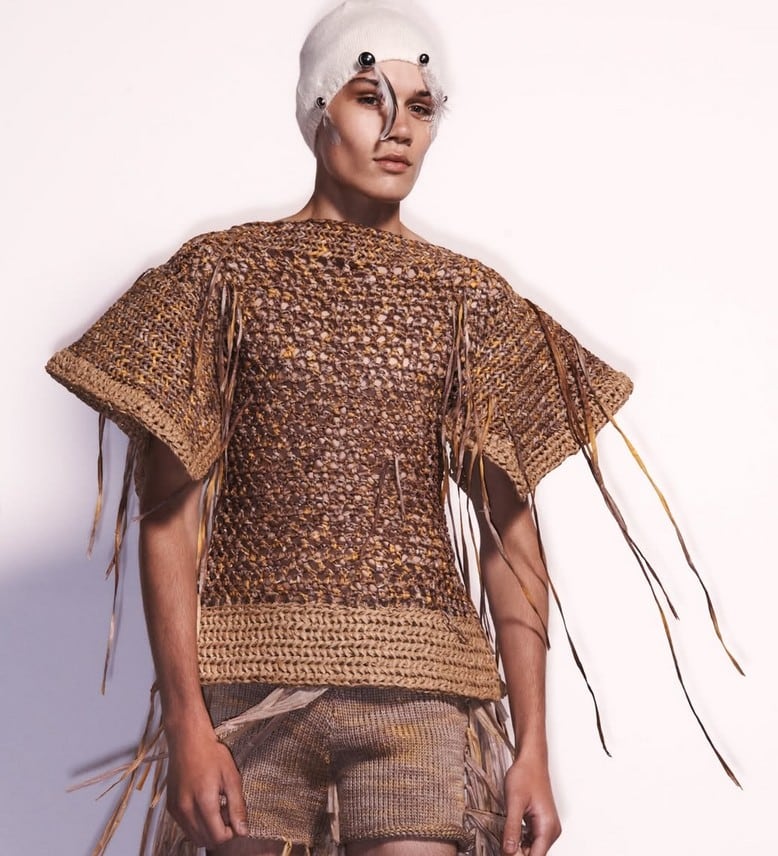
From Fair Isle to folklore to future-craft: Oscar Ouyang shows how traditional knitwear can feel radically contemporary.
Some designers rethink silhouettes. Others begin with the material—as if a garment only speaks once the yarn starts telling a story. Oscar Ouyang belongs to the second group. Beijing-born and London-based, he has developed a distinct handwriting: heritage knitting techniques without nostalgia, using knitwear as a stage for symbols, narratives, and unconventional proportions. Vogue UK frames him as a London Fashion Week debutant injecting innovative twists into time-honoured craft.
What he stands for
1) Knitwear as a language, not a seasonal trend
AnOther describes a world of “mossy knits” and “coded symbols,” with softness used intentionally.
For Ouyang, knitwear is a system—texture and pattern become meaning.
2) Tradition, made subversive
Vogue UK situates him among London designers who remix heritage knits into something chopped, reworked, and newly charged—calling his approach idiosyncratic and cult-building.
3) Gender-neutral with process-led responsibility
London Fashion Week’s official profile highlights his focus on gender-neutral fashion and sustainable knitwear and textile practices.
What makes him different
He designs for longevity—creatively and structurally.
i-D underscores his pragmatic view of the industry: designers can blow up after one hyped show, then struggle with demand and sustainability.
Ouyang’s mindset reads as long-term by design.
His references operate like mythology, not moodboarding.
Wallpaper cites influences like anime and medieval folklore, positioning him as a rising talent taking knitwear into “new realms.”
Cultural relevance with retail proof
He’s present in the LFW ecosystem and media conversation , while Dover Street Market’s buy-in signals real-world traction.
Perspective: Why We Should Be Watching Him Now
Oscar Ouyang represents a generation that does not romanticise craftsmanship, but understands it as a form of high-tech slowness: precise, labour-intensive, and meaningful. At a time when fashion often oscillates between quiet luxury and algorithm-driven aesthetics, he introduces a third position — craft as a system of storytelling.
This does not automatically make his clothes “better.”
But it does make them more idiosyncratic. And idiosyncrasy may well be the most valuable resource in contemporary design right now.