Casa Pupunha, designed by Laurent Troost and landscape-architecturally accompanied by Hana Eto Gall, is named after the peach palm. It stands as an example of what the house embodies: local rootedness, ecological intelligence, cultural significance.
The house in question is named after the pupunha palm, or in English, the peach palm. But how did this idea come about? To understand this, one must know that this palm is a genuinely Amazonian plant. The naming is therefore a conscious commitment to the place. Casa Pupunha is located in Manaus, the capital of Brazil’s largest federal state, in the heart of the Amazon.
Designed by the office Laurent Troost Architectures, the house sees itself as a structure developed מתוך the local ecosystem, not as an imported piece of architecture. The construction principles largely correspond to the characteristics of this remarkable plant: the pupunha palm is considered exceptionally sustainable; it grows quickly and is undemanding. In return, it provides generously: fruit, starch, building material. All of this can be harvested repeatedly without destroying the tree. These qualities reflect Troost’s fundamental attitude: he seeks to conserve resources and build adaptable houses with a long-term horizon.
The Garden as Protagonist
Since the landscape design – executed here by Hana Eto Gall Landscape – was understood as a cornerstone of the architecture, it was only natural to name Casa Pupunha after this living element of the garden, the peach palm.

Indeed, the garden is the true protagonist of the project. And this approach has met with international acclaim: Casa Pupunha was honored with the AHA 2025, the Architecture Hunter Award, in the category Architecture/Garden Landscape. The jury particularly praised the successful interweaving of architecture and landscape, as well as the sensitive handling of a highly complex ecological system.
To be precise, the house is located at the highest point of a residential development in Manaus, directly adjacent to a permanent nature reserve. This location is not only spectacular in terms of landscape. It also posed a central question to the planning team: How can a private retreat be created without displacing or domesticating the rainforest?
A Flowing Continuation of the Amazon Forest
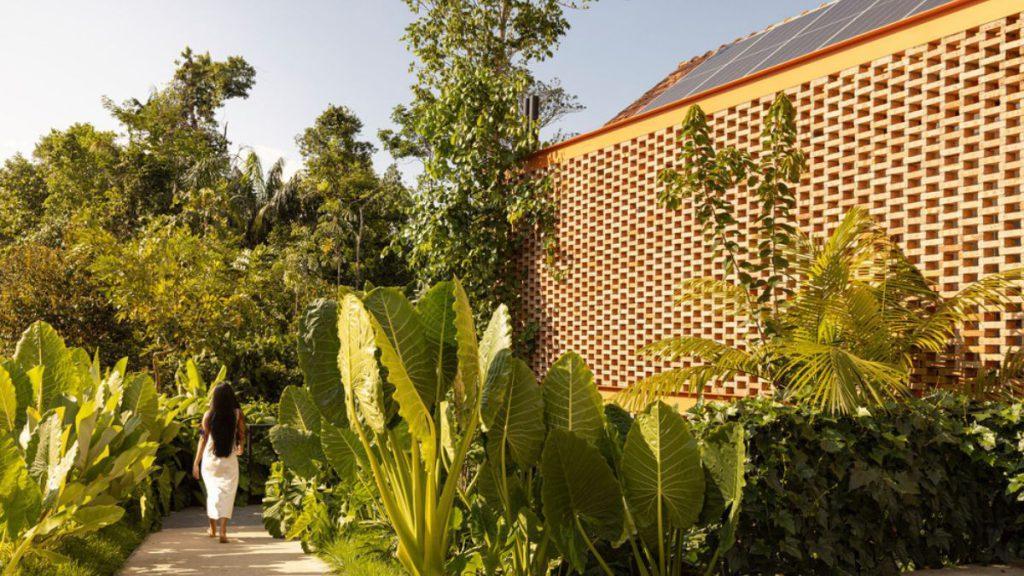
The project formulates its answer with remarkable consistency: the landscape design understands itself as a flowing continuation of the Amazon forest; the boundary between the built and the grown dissolves almost entirely.


Even the path leading to Casa Pupunha is a shift in perspective, a sensual immersion. A narrow trail runs through dense tropical vegetation, lined with large-leaved plants that allow light to filter through only selectively. The humid air and the muted sounds noticeably slow one’s arrival. Architecture initially recedes into the background.
Architecture in Dialogue with Climate and Topography
The residence itself is ingeniously oriented to the climatic conditions and the steep topography of the site. This includes optimizing natural ventilation and minimizing direct sunlight. As a result, energy demand remains limited.


The automated irrigation system is aligned with local rainfall patterns, thereby supporting the flourishing of vegetation. This also includes measures to improve site drainage and prevent erosion. Existing trees were deliberately preserved and integrated into the overall concept.
Plants as Ecological Actors
The selection of plants is another key to understanding the Casa Pupunha project. Almost exclusively native or climate-adapted species were used, such as palms, banana trees, evergreen calathea perennials, arrowleaf plants or alocasias, and heliconias, also known as lobster claws or false bird-of-paradise flowers. These plants fulfill several functions simultaneously: they create shade, regulate the microclimate, promote biodiversity, and form multilayered habitats for insects, birds, and small animals.

Every design decision connects aesthetic, ecological, and functional aspects, praised the AHA jury. The garden becomes a system that not only looks beautiful but actively contributes to the resilience of the place.
Interior and Exterior – A Permeable Boundary
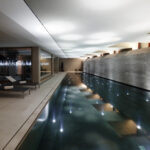
This attitude continues inside Casa Pupunha. The interior architecture by Chris Coimbra does not follow a decorative reference to nature, but allows the vegetation to literally flow into the architecture. Greenery accompanies circulation routes, frames sightlines, and becomes part of everyday living. Interior and exterior spaces are not clearly separated but form a sequence of transitions.

The result is a house that does not work against the tropical climate but with it – thus defining a different form of comfort: less controlling, yet atmospheric, adaptive, and sensual.
A Model for Tropical Living
At a time when the Amazon is increasingly under pressure, this house articulates a quiet yet clear stance: sustainability does not begin with labels, certifications, or seals of approval, but with the way we read, respect, and inhabit places.
Laurent Troost is a Belgian architect who, after studying in the Netherlands, initially worked at OMA the office of architect Rem Koolhaas. His love for Brazil and the Amazon was likely strengthened by his appointment as director of the Instituto Municipal de Planejamento Urbano da Prefeitura de Manaus (IMPLURB,the Municipal Institute for Urban Planning of the City of Manaus). He held this position until 2020.
Hana Eto Gall Landscape was founded in 2018 and is based in Manaus. With the expansion of the office’s activities to larger-scale projects such as parks and planned urban districts, the aim is to contribute to a broader understanding of landscape architecture as essential to creating spaces that enhance quality of life and strengthen the connection to nature in urban environments.
Text: Linda Benkö
Fotos: Joana França