

Villa Esencia by ELE Interior is a contemporary residential project in Dubai that integrates seamlessly into the lush oasis of Al Barari. While it references traditional Arabian architectural typologies, it reinterprets them through a modern understanding of materials and spatial design. In doing so, ELE Interior deliberately embraces the understated.
Dubai is renowned for its spectacular skyline: skyscrapers rising like futuristic sculptures into the sky, iconic landmarks such as the Burj Khalifa and the Burj Al Arab that have long since become global symbols of architecture. At the same time, the city preserves an architectural heritage that remains visible in its traditional wind towers, shaded courtyards and labyrinthine alleyways of the historic districts. Together, they reflect centuries of building traditions shaped by climate, nature and community. Positioned between these two worlds—the hyper-modern, fast-paced metropolis and the quiet, deeply rooted spaces of tradition—Villa Esencia finds its place in Al Barari.
A brief digression on the subject of wind towers, or Malqaf as they are known locally, will undoubtedly interest anyone with a passion for building technology. These remarkable structures rise above the surrounding building volumes throughout the Gulf region and parts of the Mediterranean. While they are sometimes designed as decorative architectural features, their primary function is entirely practical: they provide natural cooling for buildings. Their height ranges from around two metres above ground level to as much as fifteen metres. What they require is cool sea breezes and specially designed guiding elements at the top of the tower. These channel the wind through carefully positioned openings into the shaded interior and further down into the living spaces.

Unlike these historic structures, ELE Interior`s project is neither an architectural spectacle nor a nostalgic reminiscence. Instead, it is a consciously restrained statement—a house that places the value of tranquillity, materials and space at its core, and in doing so may even be understood as a subtle critique of Dubai’s tendency to elevate residential architecture into a symbol of status.
A Dialogue Between Architecture and Nature
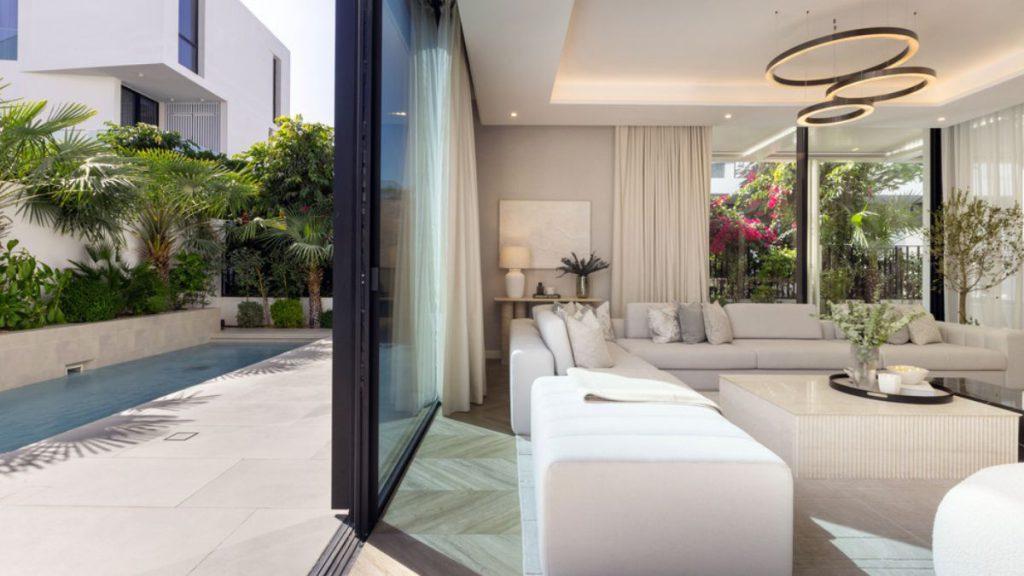
Al Barari is considered one of Dubai’s greenest enclaves. It is an oasis of densely planted gardens, flowing waterways and birdsong—an almost striking contrast to the barren desert landscapes that surround it. ELE Interior embraces this atmosphere by consistently designing the interior as an extension of nature.


At the heart of the residence lies a central courtyard that draws daylight and greenery deep into the home. This element recalls traditional Arabian architecture. Historically, however, the courtyard fulfilled not only climatic but also important social functions. In Villa Esencia, it becomes both the spatial and atmospheric anchor of the house. It remains visible and tangible from every principal area: the kitchen, living room, office and private retreat spaces.
Yet the project does not stop at historical references. The courtyard forms part of a biophilic design strategy grounded in contemporary research. Daylight, plants and natural materials have been proven to enhance well-being and promote regeneration—a quality increasingly sought by families living in today’s fast-paced urban environments. This is no different in Dubai than it is in New Delhi, New York or London.
Materiality as the Language of Silence
The project’s greatest strength lies in its material composition. Rather than relying on opulent ornamentation or bold gestures, the design brings together natural textures and a neutral colour palette to create an atmosphere of calm. The name of the residence is therefore no coincidence: everything here revolves around essence—and a remarkably pleasant one at that.

The kitchen, with its Taj Mahal quartzite island, becomes the tactile centre of the home—cool and durable, yet warm in tone. Interestingly, Taj Mahal quartzite originates in Brazil. It was most likely named after India’s famous monument because of its amber hues, beige base colour and subtly translucent appearance.
Within Villa Esencia’s courtyard, porcelain wall cladding with a travertine effect creates a visual dialogue between stone and greenery. Even the furniture throughout the residence has been custom-made, with the dining table crafted from solid travertine. Travertine itself is a fascinating natural stone. Formed in layered deposits and often resembling marble in appearance, it reveals distinctive banding when cut against the direction of its natural strata.

It is this consistent material philosophy that makes the project so convincing. While many interiors in Dubai become almost frozen in a global language of luxury defined by marble, glass and chrome, ELE Interior creates an aesthetic that feels grounded, local and authentic. One could say that Villa Esencia is a quiet response to the city’s often overwhelming display of luxury.
Villa Esencia: A Praise of Subtlety
One of the project’s key challenges was transforming the existing floor plan to better suit the family’s lifestyle. Carefully considered interventions have significantly improved everyday living. Two standard bedrooms on the upper floor were combined to create a generous master suite with two bathrooms and a walk-in wardrobe.


Another major architectural intervention involved closing the originally double-height void above the family area. This made it possible to create a dedicated playroom on the first floor—much to the delight of the children. Formally, this decision may reduce the feeling of dramatic openness. Yet here, functionality clearly takes precedence over pure representation.

Villa Esencia does not rely on spectacular vistas or iconic architectural gestures, but instead unfolds through quiet sophistication. Fabric-covered walls, bronze-tinted glass and LVT flooring define the interiors. Every detail has been carefully balanced to avoid visual excess. (LVT stands for Luxury Vinyl Tiles.)
“The Generation of Everyday Living”
Walking through the rooms, one experiences a quality that only truly reveals itself through touch: in the feel of the surfaces, in the way light moves across the stone, and in the tranquillity of the courtyard. This is what sets the project apart from the many villas in Dubai that compete for attention through visual dominance and the desire to impress friends, neighbours or guests.
With Villa Esencia, ELE Interior aligns itself with a new generation of design studios in the Emirates that seek to develop a contemporary architecture beyond iconic forms and spectacular gestures—an architecture designed for everyday life. It is a modernity that does not merely follow global trends, but draws its inspiration from local resources, climatic conditions and cultural memory.
That the Dubai-based design studio is very much on the right track is also reflected in its nomination as a finalist at the SBID Awards by the Society of British and International Interior Design in the category “Residential Property Under £1 Million.”
Text: Linda Benkö
Fotos: Aasiya Jagadeesh, Diego Delso