


South of the Ethiopian capital Addis Ababa, more than just a new airport is being created with the Bishoftu International Airport. Zaha Hadid Architects are designing an aviation center that is set to become the gateway to all of Africa as an international hub.
Between Addis Ababa and the lakes of the Great African Rift Valley lies Bishoftu – a place that until now has been known in the region as a destination for weekend trips from the Ethiopian capital or for birdwatching. It also gained tragic notoriety when, in 2019, the most devastating plane crash in Ethiopia’s history occurred here. That this very place will now become a flagship of African aviation has something almost fateful about it.

Here, around 40 kilometers south of the capital, the Bishoftu International Airport (BIA) is being built as the largest airport in the country. According to the Ethiopian government, it is set to become “the largest aviation infrastructure project in Africa’s history,” with a capacity more than four times that of the existing Bole International Airport in Addis Ababa.Ethiopian Airlines Group and the Ethiopian government commissioned Zaha Hadid Architects (ZHA) with the project, whose foundation stone was laid in January 2026.
Continental hub
The new airport is intended to secure Ethiopia’s rapidly growing role in international air transport, as Bole Airport is increasingly reaching its capacity limits. A challenge that is largely due to the country’s strategic location between Africa, Europe, Asia, and the Middle East. ZHA therefore assumed that up to 80 percent of travelers at Bishoftu International Airport will simply be transferring passengers.


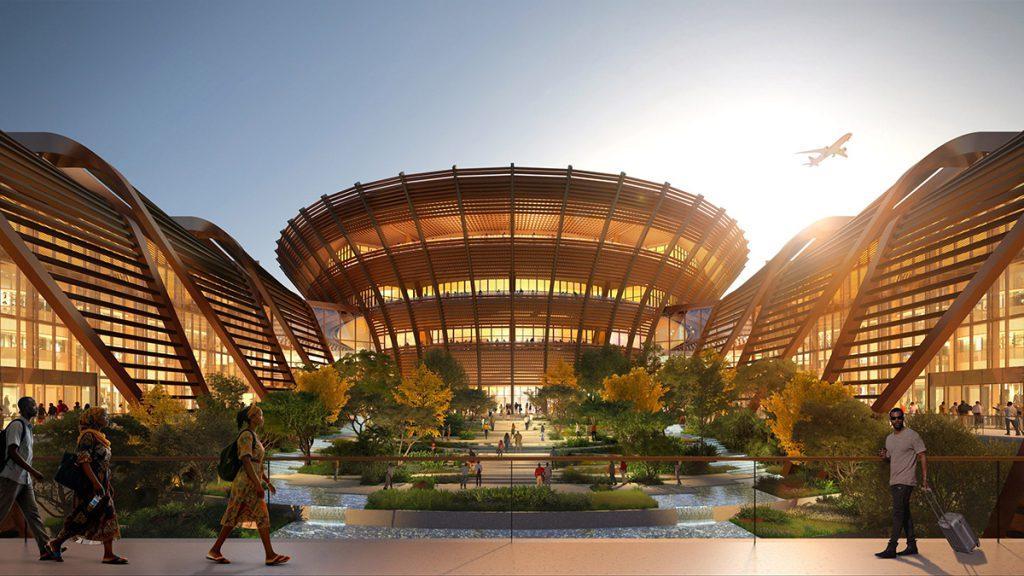
Accordingly, the studio focused on transit passengers and therefore on short distances, clear zoning, and generous waiting areas. The hub was designed with a central “spine” (“backbone”) connecting the different areas of the terminal. Inspiration was drawn from Ethiopian geography: the backbone echoes the Great Rift Valley, while the airport’s four piers symbolize the country’s regions through different colors and designs.
Exclusive waiting
Daylight, open lounges, and extensive greenery are intended to soften the classic terminal atmosphere. An airside hotel is also planned to make long transfer times more comfortable. With 350 rooms, complemented by gastronomy, entertainment, courtyards, and gardens, it aims to create retreat spaces that free transit from the feeling of waiting rooms. Luxury will not be neglected either. Frequent flyers can access the “Cloud Nine”: an exclusive lounge on the roof of the airport. Fine dining, a fitness room, and a spa included.

From a design perspective, BIA remains true to the familiar ZHA concept: organic, flowing forms with dynamic lines and curves shape the design. The strong emphasis on movement reflects the significance of motion at this place, which is never static, never standing still. Architecture deliberately becomes part of the travel experience, according to the architects.
Ideal location
The fact that an airport in the highlands does not have to function like a hermetically sealed glass box is also part of the concept. ZHA is aiming for LEED-Gold certification with natural ventilation, effective shading, and semi-open areas. Rainwater from the airfield, taxiways, and roofs will be directed into infiltration systems, while photovoltaic systems are planned as a central element of energy production. Outdoor spaces will be landscaped with resilient native plants. According to ZHA, architecture should respond more strongly to climatic realities instead of merely concealing them with technology.



The choice of Bishoftu as the future hub is of course no coincidence. The location lies about 400 meters lower than Addis Ababa. For airlines, this means better takeoff conditions: aircraft can depart with higher weight due to the higher air density, ranges increase, and operating costs decrease. At the same time, a high-capacity transport connection to the capital is being built – including a high-speed rail line. In addition, an Airport City with offices, hotels, logistics facilities, and residential districts will be developed around the terminal.
Continental hub
The goal of the responsible parties is an opening in 2030. In its first phase, the airport will feature a 660,000-square-meter terminal and two parallel runways capable of handling around 60 million passengers annually; in the long term, up to 110 million passengers are planned, supported by four runways and parking space for around 270 aircraft. With an investment volume of about 12.5 billion dollars, the project is also financially ambitious. A large part of the financing comes from international lenders, including multilateral development banks.

“The Bishoftu Airport is a visionary project. For Ethiopia and for all of Africa,” says Cristiano Ceccato de Sabata, Director of Aviation at ZHA. “Airports bring people together and bridge national borders. ZHA are honored to be part of this development: connecting all regions of the continent with one another as the gateway to Africa.”
Text: Michi Reichelt
Pictures: X-Universe