
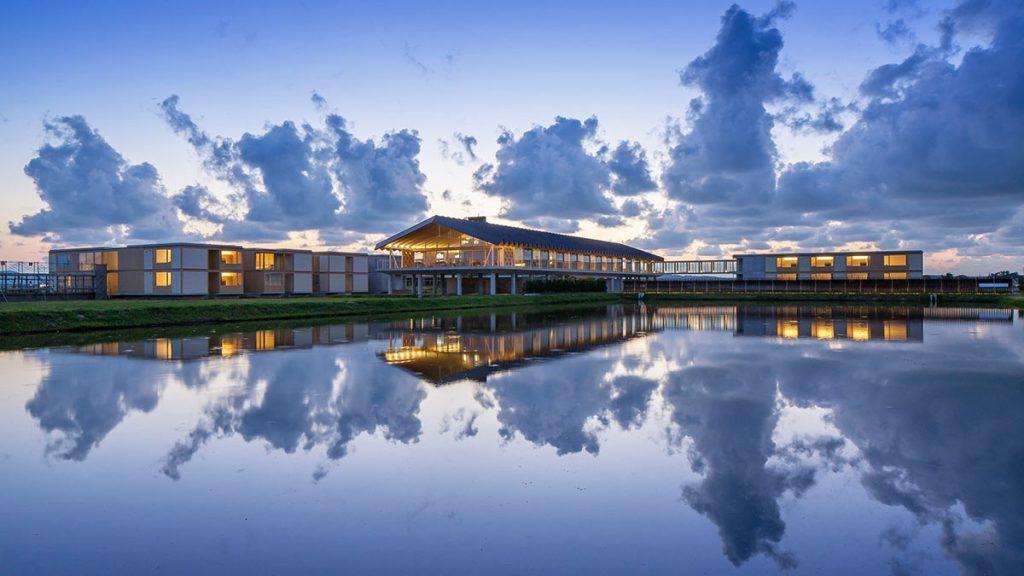
The boutique hotel Suiden Terrasse is situated in the middle of the expansive rice paddies on the west coast of Japan. This unique timber structure was designed by Pritzker prizewinner Shigeru Ban. He explained his design strategy to ubm magazine.
The Shonai plains in Yamagata Prefecture are bordered by three mountains that are among Japan’s most sacred sites. Each of them has different symbolism: Gassan is the highest peak and stands for the past, while Haguro represents the present and Yudono the future. As the snow melts on the mountains, the water runs down into the lush rice fields on the fertile plains that lie between the sea and mountains. The hotel Suiden Terrasse was built at the heart of these paddies, seemingly floating between the glassy surface of the flooded fields and the open skies above. Designed and planned by Japanese Pritzker prizewinner Shigeru Ban, the result is a place that has little in common with conventional boutique hotels.

My priority was to create a space where the architecture did not compete with its surroundings.
Shigeru Ban, architect and Pritzker prizewinner
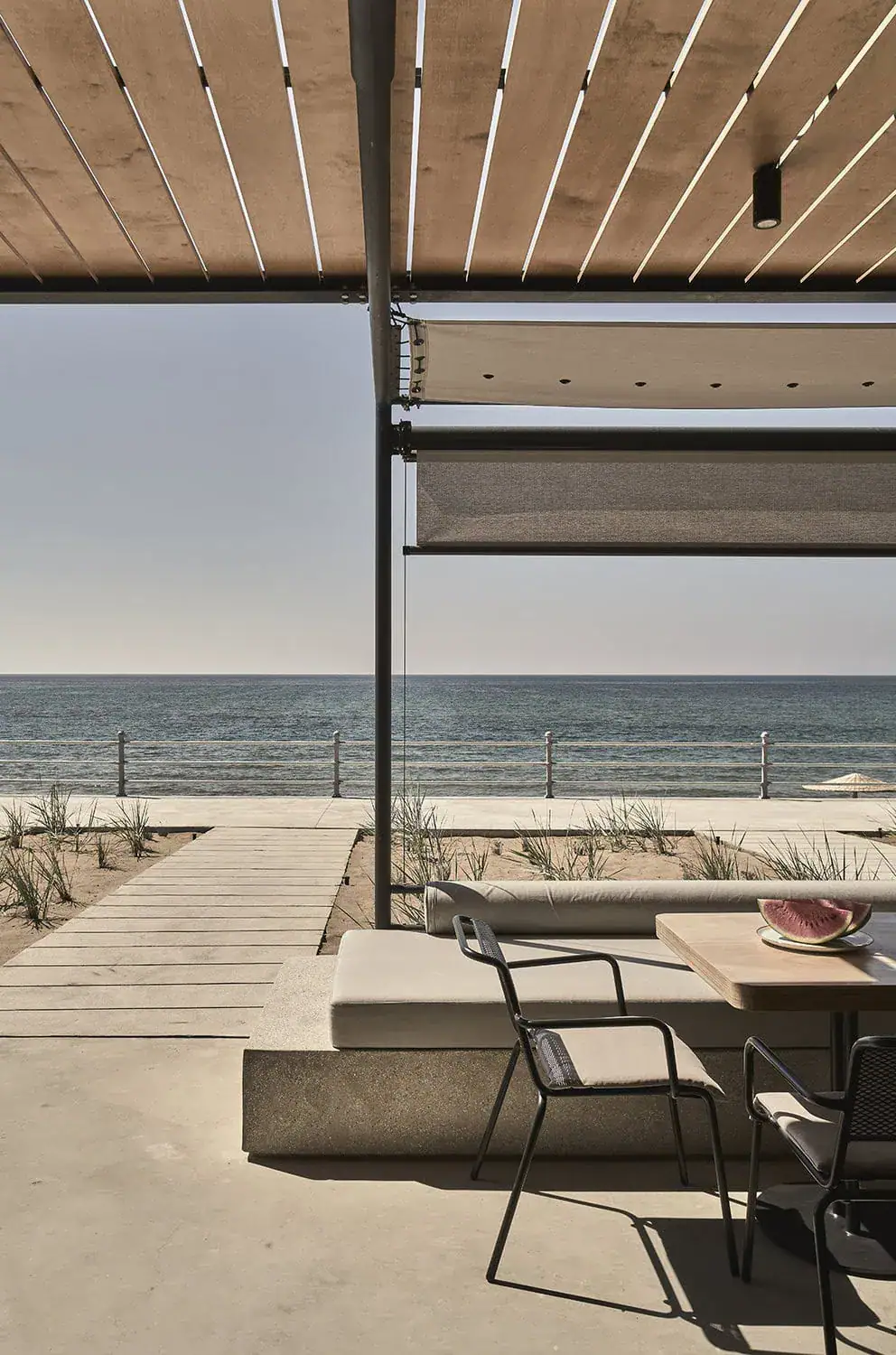
Instead of being distracted by an array of stylish designer furniture, guests have one main focus: the sweeping landscape in which the hotel has been thoughtfully positioned.
Two storeys above the landscape
The hotel rooms are equipped with all the usual necessities, but using spartan materials and producing a subdued overall effect.
Shigeru Ban described his design concept for the living areas to ubm magazine: “The hotel rooms have an unostentatious timber-frame design, deliberately avoiding any unnecessary adornment. My priority was to create a space where the architecture did not compete with its surroundings. The view of the rice field is the beautification and the actual eye-catcher.”

In order to underline the beauty of the folded wooden ceiling, I designed a slender steel frame that connects the ceiling with the remaining structure.
Shigeru Ban, architect and Pritzker prizewinner

In order to prevent the scale of the structure from being overbearing in the rice fields, the height of this boutique hotel is a maximum of two storeys above the landscape. The individual facilities are housed in different units: the main building with the lobby and communal areas, a spa area, and three accommodation wings with a total of 150 rooms.
Naturally sustainable
All projects by Shigeru Ban have one thing in common: sustainability is not an insincere premise, but instead the outcome of his holistic approach, as he remarked: “My design strategy has always been the same. I concentrate on using the existing conditions at each location in the best possible way. I observe the surroundings and respond to them. In this project, it was about saying yes to what was there, like the rice field, and making it an instigator for the overall concept. This approach benefits sustainability by working with the place instead of against it.”

Even though his client originally wanted to shut down the rice field on his land, Ban managed to preserve its existence. It was a major concern for the architect because he wanted to integrate this ancient cultural landscape throughout the changing seasons.
The rice field has become an integral part of the experience and creates a connection to nature with all its constant changes.
Shigeru Ban, architect and Pritzker prizewinner
“The rice field has become an integral part of the experience and creates a connection to nature with all its constant changes,” the 68-year-old architect continued, in conversation with ubm magazine.


Signature constructions à la Shigeru Ban
All the units have a modern timber design, and each construction has its own features. The main unit is mounted on reinforced concrete pilotis, which reinforces the impression that the structure is floating on the water. With a concrete core, the wooden building that sits atop these pilotis is open inside and out. On the facade, perforated timber walls alternate rhythmically with glass elements in the same format.
The origami-like ceiling conveys a sense of lightness, as if it were made of folded paper. “In order to underline the beauty of the folded wooden ceiling, I designed a slender steel frame that connects the ceiling with the remaining structure,” Shigeru Ban observed.

By contrast, the roof of the spa area uses the same triangular- and hexagonal-shaped Vierendeel trusses as the roof of the Centre Pompidou-Metz. When he was designing this satellite branch of the Paris art museum, the architect was inspired by the woven construction of a straw hat.
The library is also well-suited to the aspired experience of being immersed in the surrounding landscape at Suiden Terrasse hotel. It offers a selection of books that were especially chosen for the location by its own book director. In addition to the hotel guests, the reading rooms can be used by residents from the nearby town of Tsuruoka and all visitors to the location. The stoic view of the rice paddies on the Shonai plains promises a special feeling of relaxation. After all, it is here – in the shadow of the three sacred mountains – that past, present and future help maintain the right balance.
Text: Gertraud Gerst
Translation: Rosemary Bridger-Lippe
Photos: Shigeru Ban Architects